
Why Criticism Can Feel Like Rejection to a Tween Girl
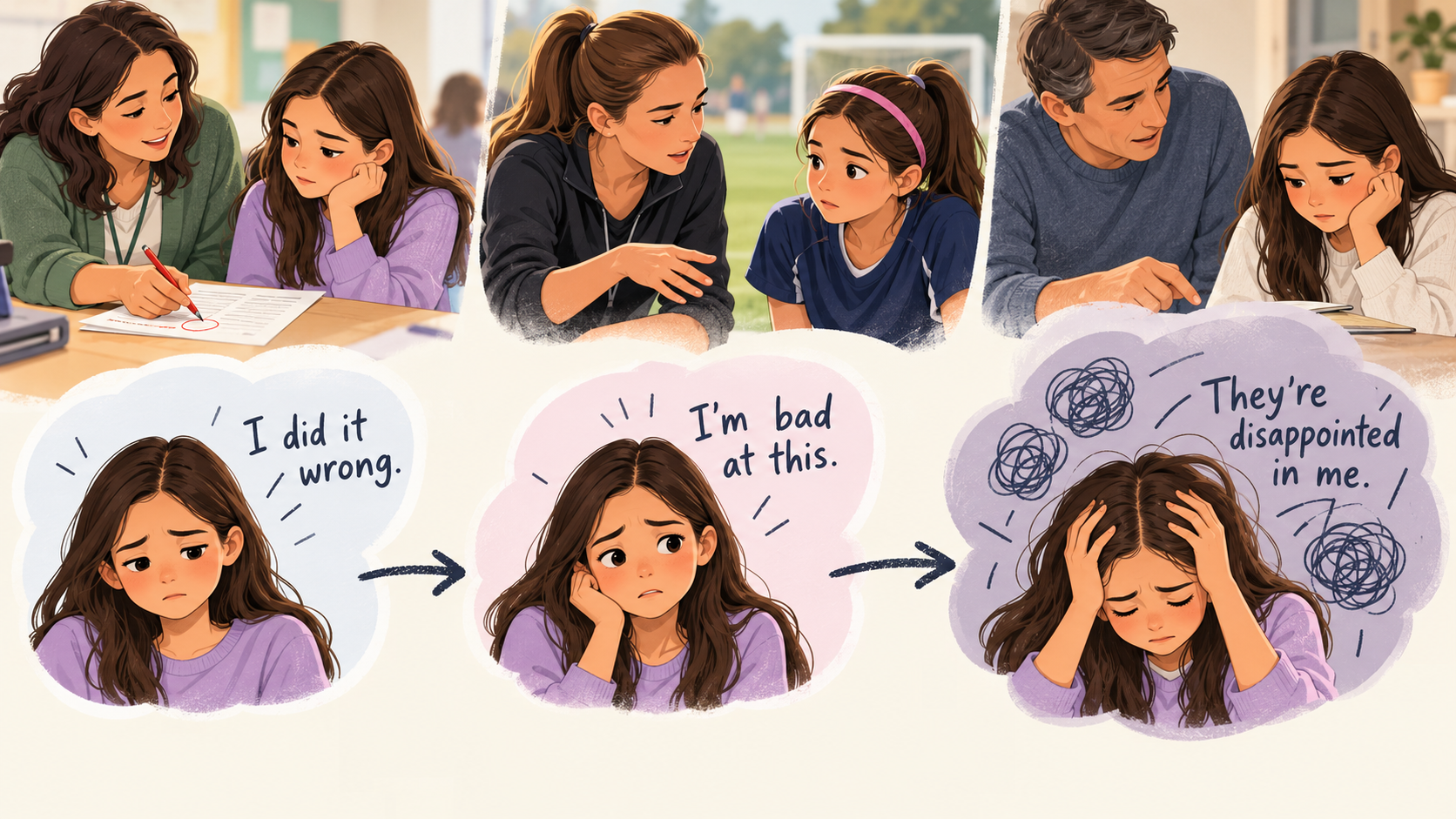
A teacher writes one correction on an otherwise strong assignment, and she sees the correction. A coach points out one part of her technique that needs work, and she hears the criticism. A parent says, “You need to redo this part,” and the comment can become much larger in her head.
“I did it wrong” may quickly turn into “I’m bad at this” and then “They’re disappointed in me.”
That distance between feedback and identity is where a lot of tween distress happens.
Feedback is supposed to provide information about performance. During adolescence, girls can begin experiencing it as information about who they are.

Why Feedback Starts Feeling Heavier
As girls become more self-aware, they also become more aware of how other people evaluate them. A correction no longer exists only as information.
It now has an audience.
What did the teacher think of me? Did the coach think I looked stupid? Is Dad annoyed because I should have known better?
That extra layer can make ordinary feedback feel emotionally loaded. Adults should not stop correcting girls. They should understand what may happen after the correction lands.
Watch What Happens After Feedback
A girl who experiences criticism as rejection is unlikely to say, “I have confused performance feedback with my sense of personal worth.”
She may slam the notebook shut, argue with every detail, cry over a small comment, insist the teacher hates her, or refuse to try again.
Those reactions can look defensive because they are defensive. If feedback feels like an attack on identity, defending herself makes sense.
The work is helping her separate what she did from who she is.
Be Specific When You Correct Something
Vague criticism gives a girl’s imagination room to fill in the rest. “This is sloppy,” “You weren’t trying,” and “You always rush” sound like descriptions of the person.
Specific feedback sounds different. “These three answers are missing the work,” “The dishes are still on the table,” or “You interrupted me twice while I was explaining” tells her what needs to change.
Specificity lowers unnecessary emotional noise. It does not guarantee she will enjoy the correction, and she is allowed to be annoyed.
The goal is not making feedback pleasant. The goal is making it accurate.
Do Not Add a Character Judgment to a Fixable Problem
A messy room is a messy room. It does not need to become proof that she is lazy.
A forgotten assignment is a forgotten assignment. It does not have to establish that she is irresponsible as a person.
A rude sentence can be addressed as rude behavior without declaring her disrespectful by nature.
Girls internalize labels quickly because identity is becoming more important at exactly the same time adults are teaching responsibility. Correct what happened and leave room for her to behave differently next time.
Help Her Ask: What Is the Information?
When criticism lands hard, a useful question is, “What part of this can you use?”
A teacher may have written several comments. One is about grammar, another organization, and another the need for more evidence. Those comments are information.
A girl can also disagree with some feedback. Confidence does not require treating every outside opinion as correct.
It requires being able to examine feedback without immediately becoming the feedback.
Separate Tone From Content
Sometimes feedback is useful and delivered badly. A coach may be impatient. A teacher may sound sharper than necessary. A parent may correct something while already frustrated.
Girls need language for this distinction too. “The tone bothered you. I understand that. Is there still any information in what she said that you need?”
That keeps two questions separate. Was the person respectful? Was any part of the feedback useful?
Both can be evaluated without pretending poor delivery cancels useful information or that useful information excuses poor delivery.
Do Not Rush to Cancel Every Criticism
When a daughter is upset, parents often want to restore equilibrium quickly. “The teacher is wrong” or “Forget what the coach said” can feel protective.
Sometimes the adult really is wrong. But if parents automatically erase all negative feedback, a girl loses the chance to learn that criticism can be survivable and useful.
She can receive a correction and remain herself. She can improve without deciding she was inadequate first.
That is a more durable form of confidence than needing every evaluation to be positive.
Teach Her How to Respond Without Defending Immediately
When feedback feels personal, the first reaction may be argument. “That’s not fair,” “I did do it,” or “She doesn’t understand.”
Sometimes those objections are valid.
Giving herself a few seconds before defending can still help. Questions such as “Can you show me what you mean?” or “What should I do differently next time?” create detail.
Detail is useful because vague threat becomes a specific problem.
Criticism Is Not the Opposite of Confidence
A confident girl does not live in a world where nobody corrects her. She lives in a world where correction does not automatically erase her sense of self.
She can hear that an essay needs work, a pass was mistimed, her tone was disrespectful, or a responsibility was missed.
Then she decides what to do with the information.
Some feedback will be useful. Some will be unfair. Some will be poorly delivered. The skill is not avoiding evaluation. It is staying intact long enough to examine it.