
The Anxiety That Comes With Asking for Help
What if the teacher thinks she is stupid?
What if other kids notice she needed help?
What if she asks and the explanation does not make sense?
What if asking shows that she does not belong in this class?
What if she becomes known as the girl who always needs help?
For many tweens, asking for help feels risky in ways that adults do not always recognize. It feels like publicly admitting failure. It feels like making herself vulnerable in an environment where she is still trying to figure out where she fits.
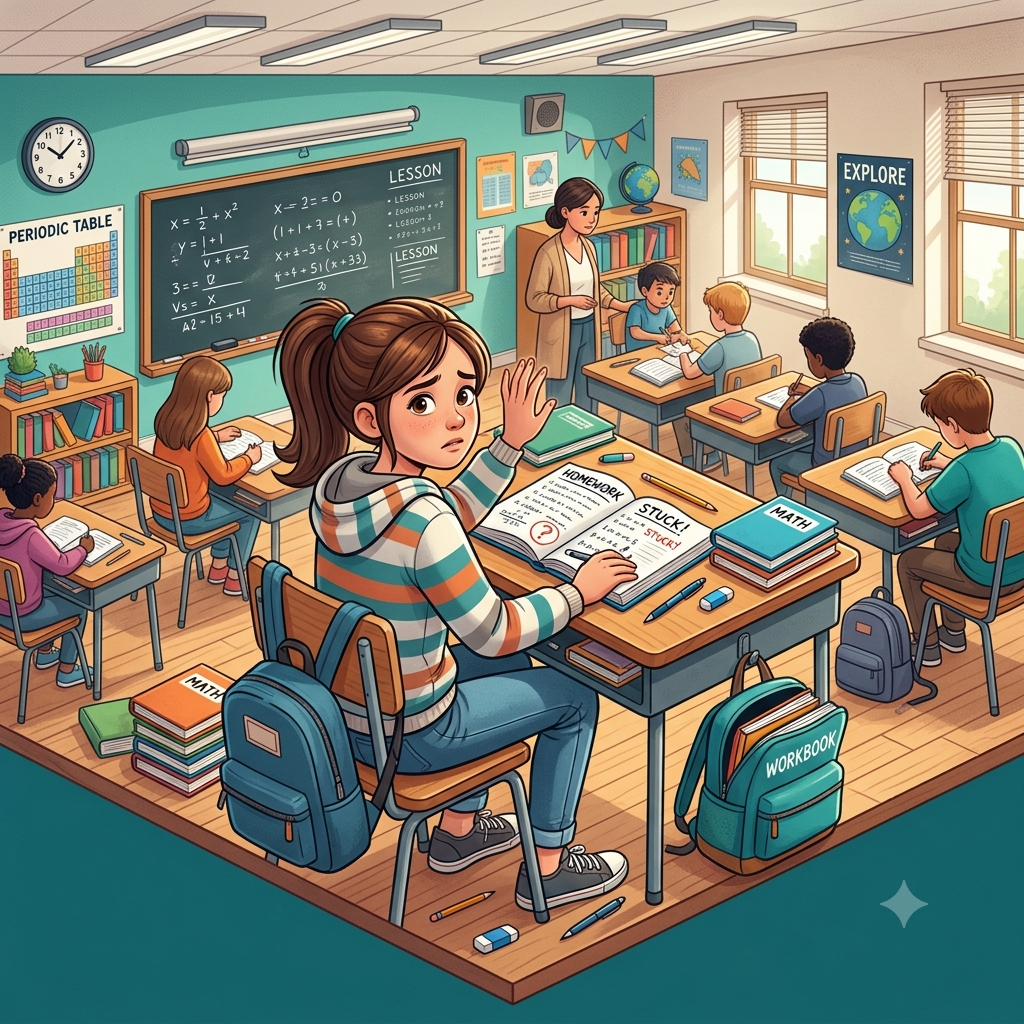
A girl is struggling in math. She does not understand the concept. She has spent an hour on her homework and feels no closer to comprehension. The obvious solution is to ask for help. But instead, she sits with the problem for another hour. She reworks it repeatedly. She looks up information online. She considers just giving up.
Everything except asking for help.
When a parent finally notices and offers assistance, the girl often seems relieved. But if a parent asks why she did not ask for help earlier, the answer is frequently vague. "I do not know. I thought I could figure it out."
What parents often cannot see is the complex web of concerns that prevented that girl from simply raising her hand and asking for help.
Why Independence Becomes Complicated During the Tween Years
Parents sometimes reinforce this dynamic unintentionally. When a girl solves a problem independently, they celebrate. When she solves it with help, the celebration is often less enthusiastic. Over time, she begins to absorb the message that solving it independently is what actually counts.
The irony is that asking for help when you need it is actually a sign of confidence, not weakness. It is a sign that a person knows her own limits and trusts that receiving help is acceptable. But many girls do not experience it that way.
Part of what makes asking for help difficult during the tween years is that independence becomes increasingly important to identity. A girl wants to be capable. She wants to solve her own problems. She wants to prove that she can handle things.
This desire is healthy and expected. Girls should be developing independence and problem-solving skills. The challenge is when the desire for independence becomes so strong that it prevents her from getting help she actually needs.
What happens is that asking for help starts feeling like admitting that independence is not possible. If she needs help, maybe she is not as capable as she thought. Maybe she does not belong. Maybe she is falling behind.
The Role of Peer Awareness in Help-Seeking
In reality, most other kids are focused on themselves, not on whether someone else needed help. But the tween brain is not always rational about social observation. It feels like everyone is paying attention. It feels like asking for help is a public announcement of inadequacy.
This is one reason help-seeking often increases in private settings. A girl might never ask for help in class. But at home, away from peer observation, she is more willing to ask a parent. The audience is smaller. The perceived risk is lower.
One factor that intensifies this difficulty is peer awareness. A younger child might ask for help without much thought to what other kids think. A tween is very aware that other people are watching.
If she raises her hand and asks for help, everyone in the class will know. The quiet smart kid might think she is dumb. The friends sitting nearby might judge her. The teacher might have thoughts about her capability.
Or at least, that is how it feels to her.
When Perfectionism Prevents Asking for Help
This is one area where parents can make a significant difference by modeling help-seeking behavior. When a parent asks for help, it demonstrates that asking is not shameful.
When a parent asks the mechanic for help with the car, asks a friend for advice, asks a colleague for input, the daughter is watching. She is absorbing the message that asking for help is part of being functional, not evidence of incapability.
Girls who struggle with perfectionism often find asking for help particularly difficult. If she cannot solve it perfectly on her own, maybe she should not solve it at all.
This creates a stalemate. The assignment does not get completed. The problem does not get solved. The girl spends hours in frustration. All because asking for help felt like admitting imperfection.
Parents sometimes discover this pattern when they realize their daughter has been working on one assignment for an unreasonable amount of time. The solution seems obvious: ask for help. But from the girl's perspective, it feels like failure.

Teaching Girls That Help-Seeking Is a Skill
Normalizing help-seeking. Talking about times when adults ask for help. "I called the plumber today because I do not know how to fix the sink. Good thing people who know how to fix sinks exist."
Celebrating the decision to ask. Recognizing the moment of asking itself, not just the outcome. "I noticed you asked your teacher for help with that problem. That was a brave choice."
Distinguishing between asking for help and asking for the answer. These are different. Asking for help is collaboration toward understanding. Asking for the answer bypasses learning. One is adaptive. One is avoidance.
One reframing that often helps is recognizing that asking for help is actually a skill that can be developed and practiced. It is not something a girl either can or cannot do. It is something she can get better at.
This distinction matters because it means help-seeking is not a reflection of capability. It is a learned behavior. Some girls learn early that asking for help is acceptable. Others have to learn it during the tween years.
Parents can support this learning by:
Creating safety around asking. When a girl asks for help, the response should be supportive, not critical. "I am so glad you asked. That is exactly what I am here for."
When Not Asking for Help Becomes a Bigger Problem
The longer a girl avoids asking for help, the more entrenched the pattern often becomes. What started as temporary reluctance becomes habitual avoidance. She misses learning because she did not ask for clarification. She falls behind because she did not ask for support. She becomes increasingly isolated because she is managing everything alone.
Parents who notice this pattern should take it seriously. It is not something that will resolve on its own. It often requires direct conversation and sometimes outside support to shift.

What Parents Can Remember
Asking for help is not weakness. It is not proof of incapability. It is actually a sign of self-awareness and wisdom. A girl who knows when she needs help and is willing to ask for it is setting herself up for success.
Parents cannot force their daughters to ask for help. But they can create environments where asking feels safe. They can model help-seeking. They can celebrate the courage it takes to admit when something is difficult.
Because one of the most important life skills is learning that we do not have to figure everything out alone.
