
Buying a Tween Girl’s First Bra Without Turning It Into a Bigger Moment Than She Wants
The first clue may not be a request for a bra. It may be a sweatshirt worn on a warm afternoon, a backpack held across her chest, or a complaint that a favorite shirt suddenly feels “weird.” She may stand in front of a drawer rejecting clothes that fit perfectly a few months ago and struggle to explain what changed.
Adults sometimes interpret this as clothing drama. Often, the clothing is doing exactly what it did before. Her body is not. A first bra can help with comfort, coverage, or tenderness, but the experience usually goes better when adults do not turn it into a milestone she is expected to feel excited about.
For some girls, buying a first bra is interesting. For others, it is practical. Some would prefer the necessary garment to appear silently in a drawer without discussion. The goal is not to create the perfect first-bra memory. It is to help her solve a new clothing problem while protecting her privacy.
How to Know When She May Want a First Bra
There is no universal age for a first bra. Puberty begins at different times, and physical development is only one part of the decision. A girl may want extra coverage because developing breast tissue is showing through shirts, because her chest feels tender, or because changing around classmates has become uncomfortable.
She may also ask because other girls are wearing bras. That can make parents question whether she “really needs” one, but need is not only physical. Clothing affects privacy, social awareness, and comfort. Wanting a soft bra because she does not want to think about her chest during school is enough of a reason to consider one.
The useful question is whether the garment solves something she is experiencing. If it reduces friction, gives coverage, or helps her feel less distracted, it is doing its job.
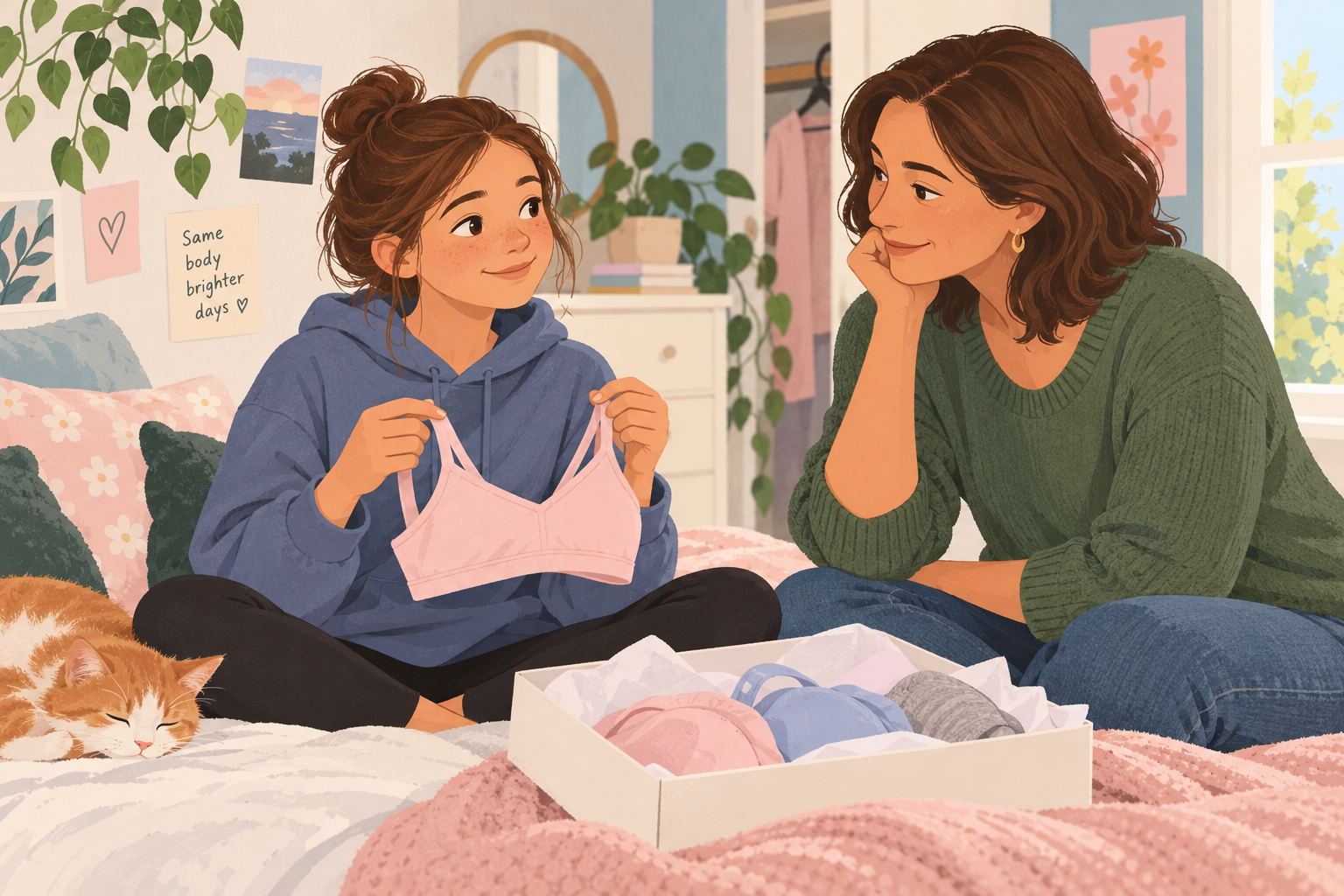
Start With Comfort, Not Cup Size
Most early bras are more about coverage and comfort than shaping. Soft fabrics, flexible bands, wide straps, and minimal hardware are often easier when a girl is getting used to wearing something new.
A first bra that pinches, scratches, rides up, or feels tight can make the entire category seem uncomfortable. A tween may assume the problem is her body rather than the garment. Adults who have spent years buying clothing know that poor fit is common, but she may not know that yet.
If the band leaves painful marks, straps dig into her shoulders, or she keeps pulling the bra down, try another size or style. If she cannot wait to remove it after ten minutes, pay attention to that too. Learning to recognize physical comfort is part of body awareness.
Give Her More Than One Option
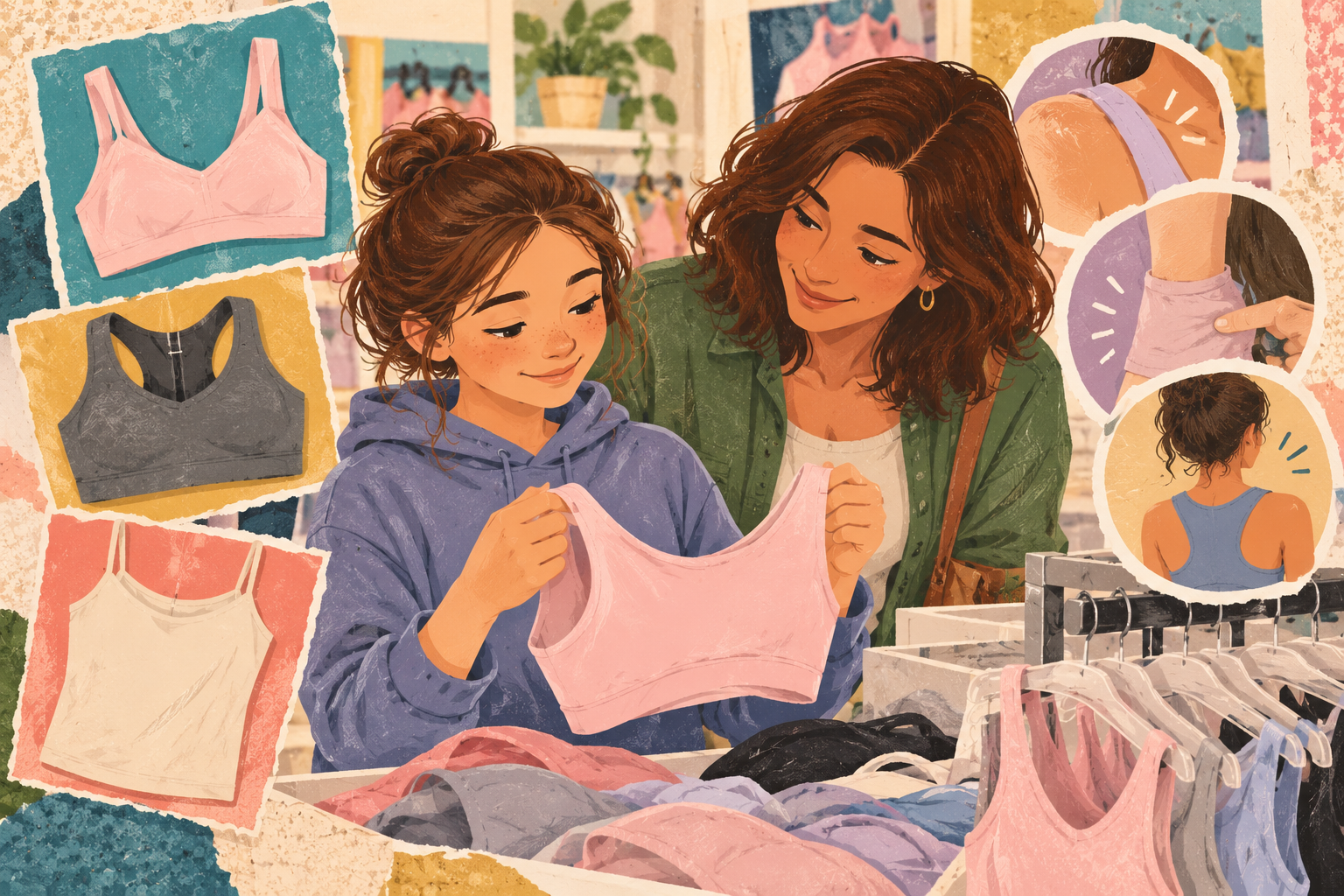
Some girls prefer a traditional bra. Others like camisoles, seamless crop tops, or sports-bra styles. There is no reason to make one particular garment the official entry point into puberty.
Let the clothing solve her actual concern. She may also care deeply about details adults consider minor, such as whether straps show beneath a school shirt or whether a seam is visible. Those concerns are not necessarily vanity. They can reflect a growing awareness that other people can see parts of her body and clothing that used to feel private.
Understanding that makes shopping more straightforward. The goal is not convincing her that nobody will notice. It is helping her find something she can wear without thinking about it all day.
Do Not Turn the Dressing Room Into an Evaluation Room
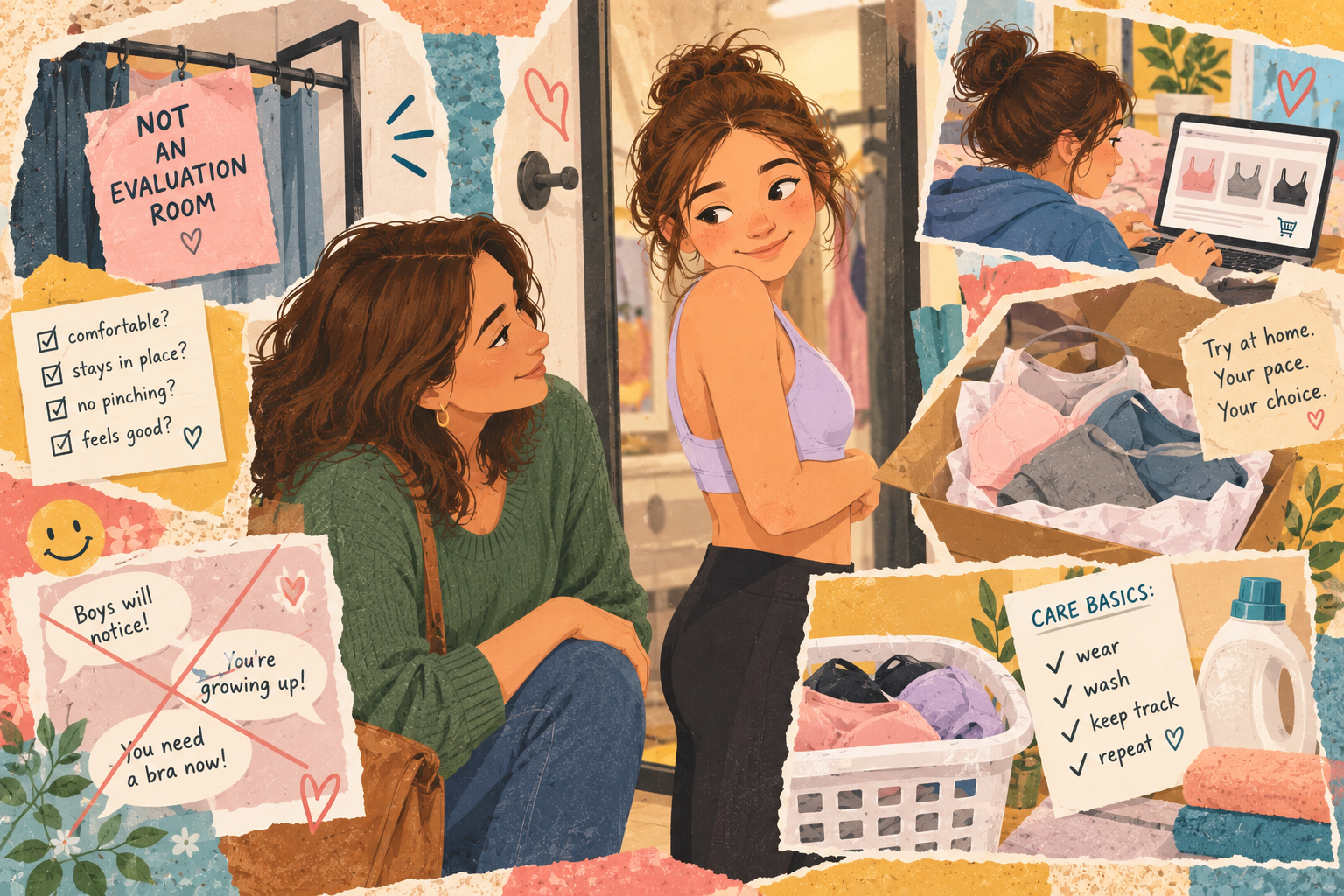
Bra shopping becomes uncomfortable quickly when adults start visually inspecting a girl instead of helping her assess the clothing. Instructions such as “Turn around” or “Let me see” may be practical, but the tone and amount of commentary matter.
Ask permission before adjusting a strap or checking a band. Explain what you are looking for and let her describe how the garment feels. Questions such as “Does the band stay in place when you move?” or “Do the straps feel comfortable?” keep the focus on function.
Her body is not being graded. The clothing is. That distinction is small in language and large in how the experience feels.
What If She Refuses to Shop?
Some girls would rather do almost anything than stand under dressing-room lights discussing their chest with a parent. That does not mean they are immature or difficult. Embarrassment can show up precisely because she understands what is happening and does not know how comfortable she is letting another person participate.
Online ordering can help. So can bringing home several sizes and letting her try them privately. A trusted adult can explain how fit works without hovering outside the door asking for constant updates.
Returns should stay ordinary too. “This one does not fit, so we’ll exchange it” solves the problem. “Why won’t you let me help you?” turns the clothing issue into a relationship issue. She may need help and still need more control over how she receives it.
Avoid Teasing, Even When It Is Affectionate
Adults often use humor when they feel awkward, but puberty is a poor place to make a girl carry that awkwardness. Jokes about needing a bra, boys noticing her, or becoming “grown” can land very differently than intended.
She may laugh because everyone else laughs, then spend the next week covering herself. The joke is over for the adults. She is still managing the attention it created.
Humor can stay in the room without using her body as the material. Laugh about impossible packaging, a fitting-room hook falling off the wall, or the fact that no one seems capable of folding certain bras properly. The situation can be funny. Her development does not need to be.
Teach Care Without Making It Complicated
A first bra adds one more clothing routine. Show her where clean bras are kept, where worn ones go, and how often they are washed based on sweat, activity, and fabric. If a garment needs special care, explain it once and keep the process manageable.
Puberty already adds more routines around deodorant, hair, skin, periods, and clothing. The goal is not to create another elaborate system adults have to supervise forever. It is to help her gradually take ownership of the items she uses.
That independence is easier to build when the rules are simple enough to remember without constant correction.
The Confidence Part Has Very Little to Do With the Bra
A first bra does not create confidence. The experience around it can still teach something valuable. When her body changes, she gets useful information. She gets choices. She gets privacy. She can say a garment feels uncomfortable without being told she is overreacting.
Those lessons matter because adolescence will bring many moments when other people have opinions about what she should wear, how she should look, and what discomfort she should tolerate. Bra shopping is one small place where she can practice noticing what she needs and saying it clearly.
Her body changes. She notices. She decides what helps. Adults support the decision without making her body public property. That is enough.