
Irregular Periods in Tweens: Why the First Few Years May Not Follow a Perfect Schedule
A girl gets her first period, and suddenly somebody in the house becomes an amateur calendar analyst. The date gets remembered, products are stocked, and everyone assumes the next period will arrive on schedule. Then day 28 passes. So does day 35.
A girl who felt prepared for menstruation can start wondering whether something is wrong because the next period did not arrive when she expected it. Or the second cycle comes earlier, the third lasts longer, and the flow changes from one month to the next. Early menstrual cycles often do not behave like a predictable subscription.
Understanding that ahead of time can keep ordinary variation from becoming unnecessary worry. The goal is not to promise that every irregular cycle is expected. It is to help girls understand that early periods may take time to establish a consistent pattern.
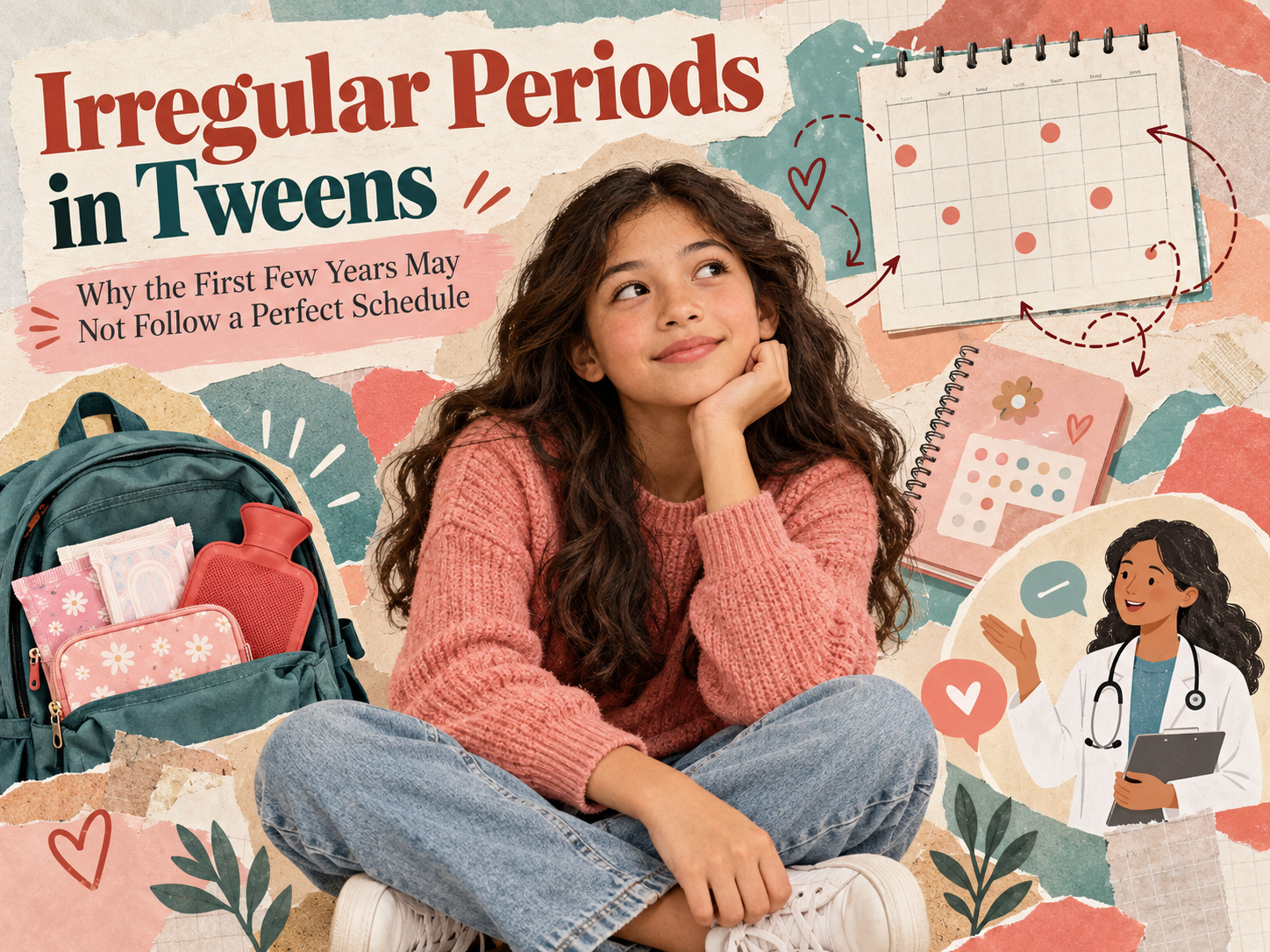
Why Early Periods Can Be Irregular
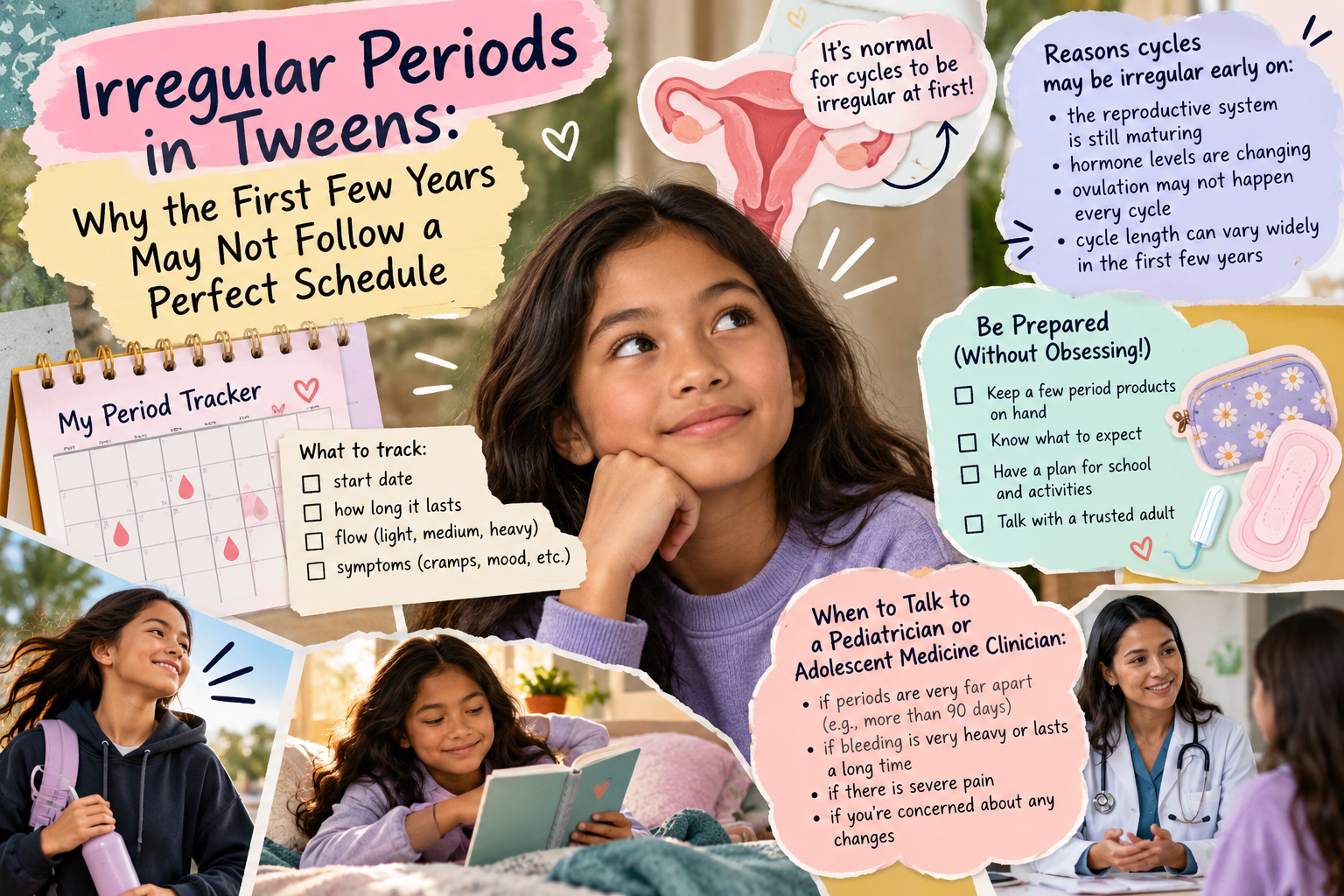
The menstrual cycle depends on communication between the brain, ovaries, and uterus. During the first years after menstruation begins, that hormonal pattern is still maturing. Ovulation may not occur predictably every month at first, which can affect cycle length and bleeding patterns.
This does not mean every unusual period should automatically be ignored. It means that perfect regularity is not necessarily the right expectation immediately after menstruation starts.
That difference matters. A girl who believes every period should arrive on exactly the same day may interpret variation as a problem. A girl who understands that her body is still establishing a pattern can observe what happens without turning every change into an emergency.
What Counts as a Menstrual Cycle?
A menstrual cycle is counted from the first day of one period to the first day of the next. That sounds simple until a girl is deciding whether light spotting on Tuesday counts or whether the period “really” started Wednesday morning.
Do not turn tracking into forensic accounting. The point is recognizing patterns over time. Marking the first day bleeding clearly begins is usually enough for basic tracking.
If she wants, she can also note how many days bleeding lasts, whether flow seems light or heavier, and whether she notices cramps or headaches. A paper calendar works. So does a notes app or a period-tracking app if the family is comfortable with the app’s privacy practices.
She does not need to track twelve categories. She needs enough information to understand what her own cycle tends to do.
Tracking Should Reduce Confusion, Not Create Another Performance Metric
Some girls love tracking. They color-code dates, remember every symptom, and could probably manage logistics for a small airport. Other girls will forget the calendar exists by Thursday.
Both can manage a period.
Tracking becomes unhelpful when a girl starts believing there is a correct menstrual score she is supposed to achieve. Bodies do not earn points for arriving on schedule. A record is useful because it helps her prepare and gives a medical professional better information if something seems unusual.
It is not a test she can fail.
What Can Change From Month to Month
Early periods may differ in timing, length, and flow. One month may be light, another heavier. Cramps may be mild at first and stronger later, or the opposite. Premenstrual symptoms can also change.
The practical lesson is that the first period does not reveal exactly what every future period will be like. A girl who assumes the first month established permanent rules may feel blindsided when the next cycle looks different.
Preparation should account for uncertainty. Keeping a few period products and spare underwear in a school bag can help without requiring her to predict an exact date. She does not need perfect timing to be prepared.
When Irregularity Is Worth Discussing With a Doctor
Menstrual variation can happen after periods begin, but some patterns deserve medical attention. Parents should contact their daughter’s pediatrician or adolescent medicine clinician if they are concerned about very heavy bleeding, severe pain, dizziness or fainting, bleeding that lasts unusually long, or periods that stop for an extended time.
A clinician can evaluate the individual pattern and decide whether it falls within expected development or requires further assessment. This article is educational and should not replace personal medical advice.
The important distinction is between understanding common variation and dismissing symptoms. Girls should learn that they do not need to panic over every irregular cycle, and they also do not need to ignore something that feels significantly wrong.
Do Not Make Her Period a Household Tracking Project
There is a practical difference between helping a girl understand her menstrual cycle and repeatedly asking whether she has started. “Anything yet?” and “Did your period come?” may sound helpful to a parent and feel intrusive to a tween.
If she is old enough to track the information herself, let her own some of it. You can explain what changes should be brought to your attention and what symptoms deserve medical advice, then give her space.
That approach teaches something useful. Her body is her responsibility, and support is available when she needs it. She does not have to submit routine updates about every cycle in order to receive help.
Why Predictability Feels So Important at This Age
Puberty introduces uncertainty in multiple places at once. A girl does not know exactly when she will grow taller, when acne will show up, whether her emotions will cooperate before a school presentation, or whether a period will arrive during a sleepover.
A calendar can feel like control. Then menstruation refuses to behave like a train timetable.
The answer is not pretending uncertainty can be eliminated. The answer is making it manageable. She can carry supplies, notice early signs, track what happens, and ask questions when something changes.
That is more useful than teaching her that a healthy body should behave perfectly on schedule.
The Goal Is Familiarity With Her Own Pattern
Over time, many girls begin recognizing patterns in their cycles. They may notice approximate timing, cramps, changes in discharge, appetite, energy, or mood. That familiarity develops through experience.
It should not become another reason to watch herself anxiously. A period arriving earlier than expected is information. A cycle running longer than last month is information. Information can be observed without immediately becoming judgment.
That distinction matters beyond menstruation. Puberty asks girls to notice their bodies without turning every observation into proof that something is wrong. Periods are one of the first places where they can practice that skill.