
How to Start the Puberty Talk Without Making It Weird
You have been meaning to have this conversation for six months.
You keep waiting for the right moment. A quiet car ride. A calm Saturday morning. A day when she's not already annoyed about something else.
The moment never quite arrives.
And now she's nine, or ten, or eleven, and something in you knows the window is either open right now or quietly closing.
Here's the truth most parents don't say out loud: the talk doesn't have to be one big sit-down moment. It doesn't have to be uncomfortable. And it definitely doesn't need to be perfect.
It just needs to happen.

Why Parents Keep Stalling, And Why That's Worth Understanding
Most parents who delay this conversation aren't doing it out of negligence.
They're doing it because they don't want to say the wrong thing.
They remember their own experience; maybe it was awkward, or late, or nonexistent, and they don't want to recreate it. So they wait for certainty they never quite feel.
Here's what the research actually says: girls who receive accurate, early information about puberty from a trusted adult feel significantly more confident when changes arrive. Not just physically, but emotionally. They feel less alone.
The fear of saying it wrong is almost always bigger than the damage of saying it imperfectly.
Your daughter doesn't need a flawless presentation.
She needs to know you're the person she can come to.
The Age That Matters More Than You Think
Most parents assume puberty starts around 12 or 13.
Pediatric guidelines have shifted. The American Academy of Pediatrics now considers breast development occurring between ages 8 and 13 to be within the typical range. Body odor and pubic hair can appear even earlier.
That means a third grader can begin puberty.
If your daughter is between 8 and 10 and you haven't started the conversation yet, you're not behind; but you're right on time.
The goal isn't to overwhelm her with information she doesn't need yet. It's to open a door early enough that she doesn't feel blindsided when her body starts changing.
What "The Talk" Actually Needs to Cover First
Forget the full anatomy lesson for now.
The first conversation has one job: normalize what's coming so she's not scared when it arrives.
Here are the three things every girl needs to hear early:
1. Her body is going to change, and that's normal
Say it plainly. No dramatic buildup. "At some point, probably in the next few years, your body is going to start changing. It happens to every girl. It's called puberty."
That's it. You've opened the door.
2. She won't be alone in it
This is the one that matters most.
"I want you to know that you can always come to me with questions. Nothing is too weird. Nothing is off-limits."
She may not take you up on it immediately. But she will file it away. And she will come back to it when she needs it.
3. Changes come in different orders for different girls
One of the biggest fears tween girls carry is thinking something is wrong with them because they started before their friends, or after. Or because their experience doesn't match what their friend described.
Tell her ahead of time: "Everyone's body does this a little differently. There's no right timeline."
You've just eliminated a significant source of anxiety before it even forms.

Scripts That Actually Work
Most parents freeze because they don't know how to start.
Here are a few openers that feel natural rather than rehearsed:
If you want to bring it up casually: "Hey, I've been meaning to talk to you about something. Nothing bad — just stuff about your body that's coming up for a lot of girls your age. Can we talk for a few minutes?"
If something already happened (she asked a question, or you noticed a change): "You know what, this is actually a great time to talk about something I've been wanting to explain to you. You asked about [X], and there's more to it than a quick answer."
If she seems embarrassed or shuts down: "I get it. This stuff feels weird to talk about. It felt weird for me too when I was your age. But I'd rather you hear it from me than figure it out alone."
You don't need to memorize a script. You need one real sentence to start.
Everything after that is easier.
What to Do When She Shuts You Out
Some girls respond to this conversation with enthusiasm. Questions, follow-ups, curiosity.
Others go quiet. One-word answers. Visible discomfort.
Both are completely normal responses.
If she shuts down, don't push. Don't interpret silence as rejection.
Try this instead:
"You don't have to say anything right now. I just wanted you to know we can always talk about it."
And then drop it.
The fact that you said it, that you didn't avoid it, is what she will remember.
Some of the most important conversations parents have with their daughters are the ones the daughter barely responded to in the moment. The message still landed.
The Books, the Apps, and the "I'll Just Send Her a Link" Approach
A lot of parents solve the conversation problem with a resource.
They buy a book. Drop it on the bed. Hope she reads it.
Sometimes it works. But there's a risk in leading with a book and stopping there.
If you hand her a book and disappear, the message she receives isn't just "here's information." It's "I'm not comfortable talking about this with you directly."
Books and resources are a great complement to conversation. They're not a substitute for it.
If you do use a book, and there are genuinely good ones, like our Tween Girls Puberty Confidence Code, use it as a conversation starter.
"I got you something I wish I'd had when I was your age. Want to look at it together?"
That one sentence turns a handoff into a connection.
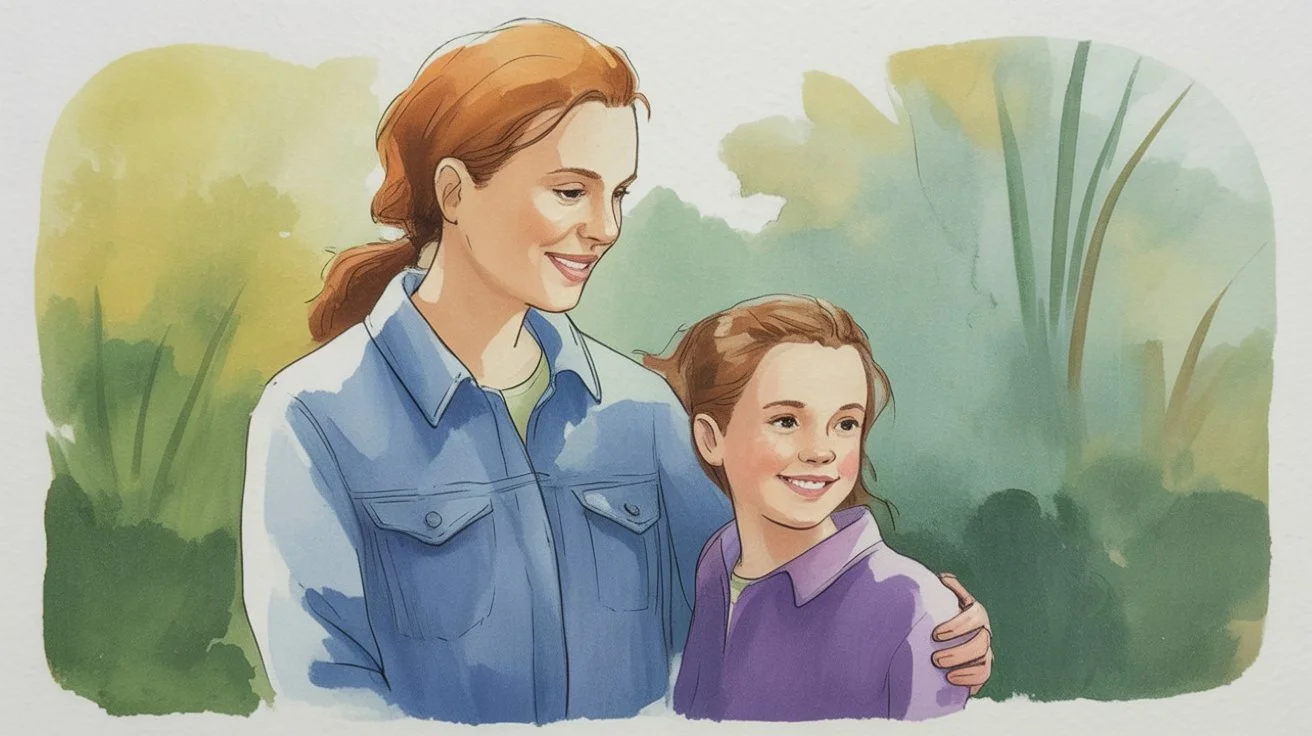
The Conversation Doesn't End Here
One conversation is a start. Not a finish.
Puberty unfolds over years. So does your daughter's need to talk about it.
The goal isn't to have one perfect talk and check it off the list.
The goal is to become the person she thinks of when something confusing happens — when she notices a change, when a friend says something alarming, when she has a question she's too embarrassed to Google.
That kind of trust is built incrementally.
A small comment here. An open question there. A book left on the counter without pressure.
It's not built in one conversation.
But it starts with one.
A Few Things Worth Remembering Before You Start
You don't need to know everything. If she asks something you don't know, say so. "That's a great question. Let me find out and come back to you." That models intellectual honesty, not ignorance.
You don't need to be calm the whole time. If it feels a little awkward, you're allowed to say that. "I know this feels a little weird. I think that's okay."
You don't need her to respond perfectly. A blank stare is fine. A mumbled "okay" is fine. You're planting something. It doesn't have to bloom in the next five minutes.
And you don't need to do it alone. There are good books, good resources, and yes — a good reason to keep reading this blog.
Because the more informed you are, the more confident she gets to be.