
How Tween Girls Can Recover From Embarrassment Without Replaying It for Three Days
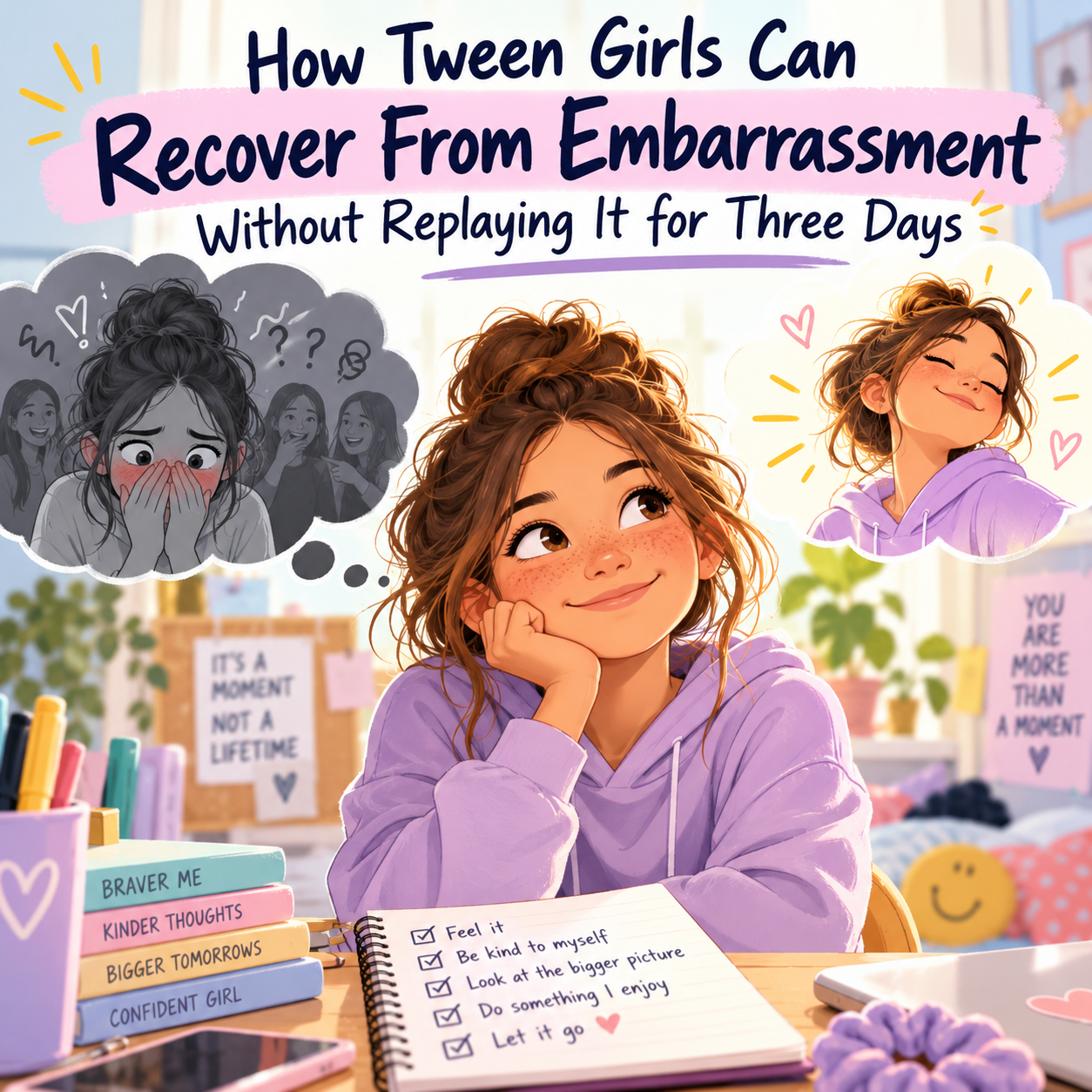
She answers a question confidently in class and gets it wrong. Somebody laughs. The moment lasts a few seconds.
Her brain may schedule it for the next three days.
At dinner, she remembers it again. While brushing her teeth, she replays the teacher’s face. In bed, she reconstructs who was sitting where and whether the laugh came from the second or third row.
Embarrassment has a strange sense of time. The event ends, but the body and mind can keep reacting as though it is still happening.
Why Embarrassment Feels So Physical
Embarrassment is not only a thought. A girl may feel heat in her face, tension in her stomach, a racing heart, or an immediate urge to disappear.
That physical reaction is one reason “forget about it” rarely works. Her body has already marked the event as important.
She does not need a lecture about why she should stop caring. She needs time for the reaction to settle and perspective about what the moment actually means.
Understanding that keeps parents from arguing with the feeling while missing the pattern underneath it.
Social Awareness Makes Small Mistakes Feel Public
A younger child may trip, get up, and continue toward the swings. A tween may trip and immediately scan the area to determine who saw it.
The fall is only part of the experience. The imagined audience is the other part.
Adults sometimes underestimate embarrassment because they focus on the mistake itself. She is focused on the fact that other people witnessed it.
Both are facts. Only one is keeping her awake later.
Do Not Argue About Whether It Was Embarrassing
“You have nothing to be embarrassed about” may sound comforting, but it can miss what happened. Maybe she answered incorrectly in front of thirty people and two classmates laughed.
That can feel embarrassing.
A steadier response is, “That sounds embarrassing. What happened after that?” The question moves time forward.
She answered incorrectly, somebody laughed, and then the teacher continued. Another student answered. Lunch happened. The school day kept moving.
Embarrassment often freezes attention on one frame. Helping her see the frames that came after restores proportion.
Ask What She Thinks Everybody Else Is Thinking
This is useful because assumptions become easier to examine once they are specific. She may say, “Everyone thinks I’m stupid now.”
Then you can ask what evidence she actually has. Did anyone say that? What happened after class? Did her friend act differently?
Often, ordinary details tell a different story. A friend may have asked for a pencil. Another classmate may have been talking about lunch.
The world in her head is still centered on the embarrassing moment. The actual world has usually moved on.
Avoid Telling Your Own Bigger Embarrassing Story Too Quickly
Parents often try to help by raising the stakes. “You think that’s bad? When I was twelve, I fell onstage in front of the whole school.”
The intention is generous. The timing can make a girl feel as though her embarrassment is being competed with.
Let her experience belong to her first. Later, a personal story may help show that embarrassing memories lose power with time.
She should not have to lose the contest before she is allowed perspective.

Give Her Something to Do With the Replay
When the same memory returns repeatedly, teach her to identify that process. “The event is over. Your brain is replaying it because it felt socially important.”
That is more useful than “stop thinking about it.”
She can ask herself whether anything still needs to be fixed. If she hurt someone, there may be a repair to make. If she gave a wrong answer in class, there may be nothing left to do.
Once the practical part is complete, replay is no longer problem-solving. It is repetition.
Recognizing that can help her disengage from it.
Humor Can Help, but Timing Matters
Embarrassing moments often become funny later. Later matters.
If a parent laughs while a girl is still burning with embarrassment, the joke adds another witness. When she starts finding the absurdity herself, humor can help create distance.
The wrong answer that felt catastrophic on Tuesday may become a story next month. Let her decide when it has crossed that line.
Humor works best when it follows recovery rather than replacing it.
Confidence Is Not Being Hard to Embarrass
Girls sometimes assume confident people never feel awkward. Adults reinforce this when we praise someone for being “unbothered.”
Social embarrassment is a normal response to feeling exposed.
Confidence is not immunity. It is recovery. A girl can turn red, wish she could disappear, replay the event on the bus, and still return to class tomorrow willing to participate again.
That return matters more than whether she felt embarrassed.
Do Not Let Avoidance Become the Solution
After an embarrassing mistake, a girl may decide never to risk that feeling again. She stops raising her hand, quits the activity, avoids the person, or refuses to perform.
Avoidance works immediately. She cannot get an answer wrong in class if she never answers.
The relief has a cost. The mistake begins deciding what she is allowed to do.
Help her return in a manageable way. She does not need to become the first hand in the air tomorrow. She does need enough experience learning that embarrassment is survivable.

The Moment Shrinks When Her Life Gets Bigger Again
Embarrassment expands when all attention stays on it. Recovery often happens by returning to ordinary life.
Homework, dinner, practice, a show, texting a friend, and packing for tomorrow all give the brain newer information.
Nothing profound has to happen.
That is the quiet end of most embarrassing moments. The moment simply stops being the most important thing in the room.