
When Smart Girls Start Doubting Their Intelligence
Younger children often have confidence without scrutiny. They think something and believe it. They do not yet have the cognitive ability to imagine alternative perspectives or recognize gaps in their knowledge. That inability is actually helpful for confidence. It allows children to move forward without constant doubt.
As girls enter the tween years, that changes.
They become capable of more sophisticated thinking. They can recognize complexity. They can imagine what they do not know. They can hold multiple perspectives in mind at the same time. These are important cognitive developments. They are signs of growing maturity.
The challenge is that this expanded thinking capacity often arrives with a side effect.
Girls suddenly become aware of everything they might be wrong about.
A girl who has always understood material quickly begins raising her hand less often. She used to trust that if she thought something, her thinking was probably correct. Now she finds herself second-guessing answers she instinctively knows. She double-checks her work obsessively. She rewrites emails multiple times before sending them. She listens to classmates' ideas and assumes they must have something she is missing.
Parents notice this shift and feel confused. Their daughter's grades remain strong. Her teachers still describe her as capable. Yet something has changed in how she views her own intelligence. She seems less certain. Less willing to commit to her ideas. More doubtful of her ability to think things through.
What many parents miss is that this is not actually a change in her intelligence.
It is a change in her awareness of intelligence.
When Awareness Becomes Obstacle
For girls who have built identity around being smart, this moment can be particularly uncomfortable. Intelligence felt like a reliable characteristic. It was something she could count on. Now even that feels uncertain.
Parents sometimes try to solve this by offering reassurance. "You are smart. Trust yourself." But reassurance often misses what the girl is actually experiencing. She is not looking for someone to tell her she is smart. She is grappling with a new kind of thinking that makes her feel less certain about everything.
Understanding this distinction helps parents respond with more accuracy. This is not a confidence crisis. It is the growing pain of developing a more complex mind.
The irony of becoming smarter is that it often creates more opportunities for doubt.
A girl used to think, "I know this answer." Now she thinks, "I think I know this answer, but what if I'm missing something? What if there's a perspective I haven't considered? What if someone else's thinking is actually better than mine?"
This shift in thinking style is developmentally appropriate. It is part of becoming a more sophisticated thinker.
The problem is that it can feel a lot like loss of confidence.
The Trap of Perfectionism Disguised as High Standards
Parents sometimes view this as admirable dedication. In some cases, it is. In other cases, it is anxiety wearing the mask of ambition.
A girl who is trying to manage doubt through perfectionism is often working from a place of fear rather than enthusiasm. The stakes feel higher because the uncertainty feels more real.
This is one reason it becomes important to help girls distinguish between high standards and impossible standards. High standards can motivate. Impossible standards paralyze.
Many intelligent girls respond to this new uncertainty by tightening their control. If they cannot trust their thinking, perhaps they can trust their effort. If they cannot be sure they are right, perhaps they can work harder to make sure.
This often manifests as perfectionism.
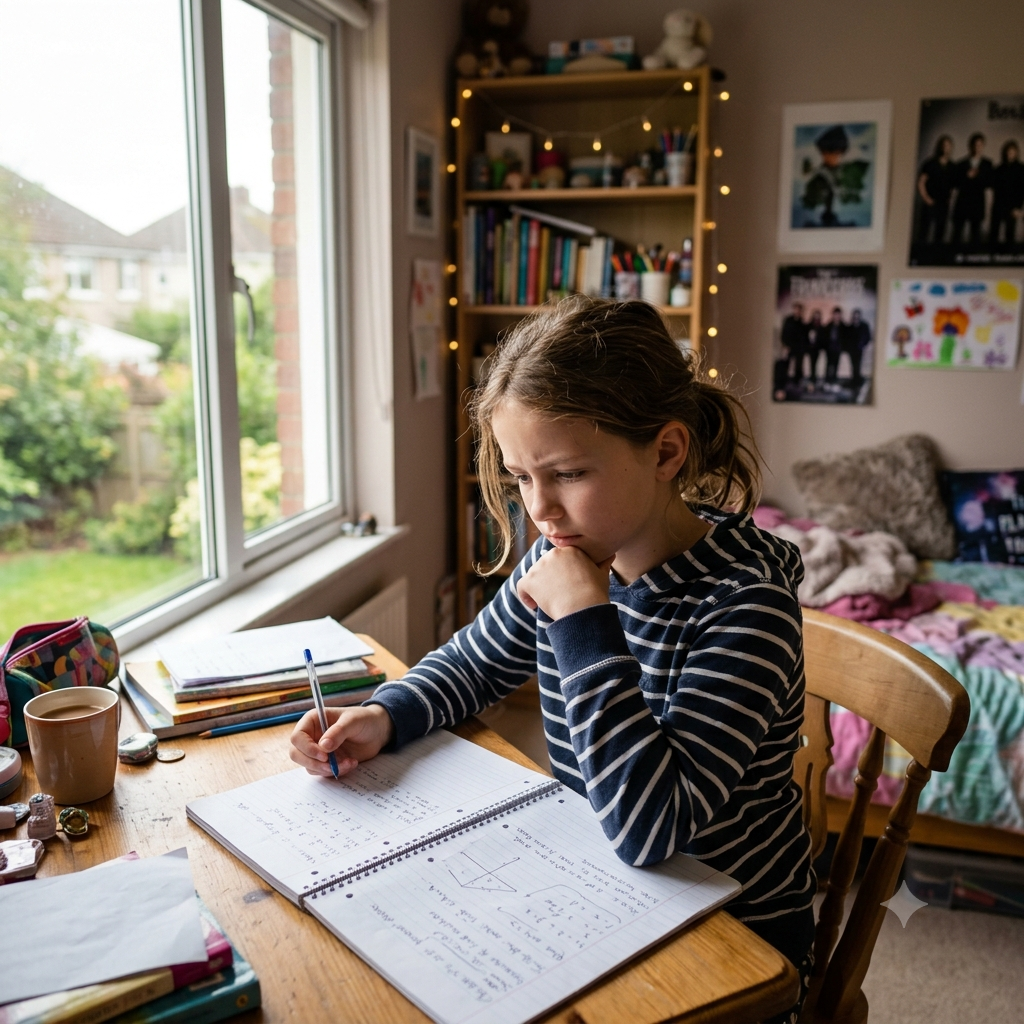
The girl who used to be satisfied with good work suddenly needs it to be perfect. She spends hours on assignments that should take thirty minutes. She rewrites everything multiple times. She becomes frustrated with herself for making small mistakes. She treats every assignment like it will determine her entire academic future.
Why Comparison Intensifies Intellectual Self-Doubt
Suddenly being smart does not feel as special. There are other girls who are smart too. Some who might be smarter. This realization, while developmentally normal, can shake the foundation of identity for a girl who built it primarily around intelligence.
She begins comparing her thinking to other people's thinking. She assumes other girls' confidence means they actually are smarter. She interprets their silence as humility rather than their own uncertainty.
What she does not see is that those other girls may be experiencing similar doubt. They may simply be hiding it more successfully.
One factor that often accelerates this pattern is comparison. In earlier years, a girl may have been the clearly smart one in her peer group. She got the good grades. She understood things quickly. She felt special because of her intelligence.
The tween years often introduce a new variable.
More competition.
More visibility around achievement.
More awareness that there are many smart girls.

The Difference Between Doubt and Lack of Ability
Parents can interrupt this loop by naming what they are observing.
"I notice you are questioning yourself a lot. I also notice that when you finally do try, things usually go well. I wonder if the doubt is not actually evidence about your ability. Maybe it is just evidence that you are thinking deeply about complex material."
That kind of observation does not dismiss the doubt. It simply puts the doubt in a different context.
One of the most important distinctions parents can help girls make is recognizing that doubt and inability are not the same thing. A girl can doubt herself while still being capable. She can question her thinking while still thinking well.
Many intelligent girls begin to assume the opposite. They interpret their doubt as evidence that they actually are not as smart as they thought. If they were truly smart, they would not feel uncertain.
This creates a painful loop. Doubt leads to the belief that she lacks ability. That belief leads to more caution. More caution leads to less willingness to participate. Less participation leads to less opportunity to discover that she actually is capable.
Building Confidence in Intellectual Uncertainty
Many of the smartest adults still experience intellectual doubt. They have simply learned that doubt does not get to prevent them from contributing. They have learned that being uncertain and being capable can be true at the same time.
Girls are more likely to develop that kind of confidence when they have opportunities to experience it themselves. When they participate despite doubt. When they discover their contributions matter. When they realize that admitting uncertainty is not the same as admitting incapability.
The goal is not eliminating doubt entirely. That is not realistic for sophisticated thinkers. The goal is helping girls learn to function well even while doubt is present.
This means practicing participation even when she is not one hundred percent certain. It means practicing being wrong and discovering she survives it. It means noticing that uncertainty and intelligence can exist together.

What Parents Can Remember
The shift from unexamined confidence to scrutinized thinking is part of growing up. It can look like lost confidence. It often reflects growing intelligence.
Girls do not need parents to convince them they are smart. They need parents to help them understand that the smartest people are often the ones who doubt themselves the most. They question assumptions. They recognize complexity. They understand the limits of their knowledge.
That is not weakness.
That is actually evidence of genuine intelligence.
