How to Talk to Your Daughter About Her First Period
Parents worry about saying the wrong thing when it's time to talk about periods. They wait for the "right moment," hoping the conversation will happen naturally. But by the time that moment arrives, many girls have already heard confusing or inaccurate information from friends, social media, or school. The goal isn't to have one perfect talk, it's to make sure your daughter has accurate, reassuring information before she needs it, so her first period feels expected rather than frightening.
How to Talk to Your Daughter About Her First Period Before It Actually Happens
I waited too long with my first talk. I kept looking for a natural moment that felt significant enough, and by the time I brought it up, my daughter had already heard a garbled version from a classmate that scared her more than it informed her. The conversation I'd been planning as a meaningful milestone ended up as damage control instead.
Why Timing Matters More Than Parents Expect
A lot of parents wait for a sign, a growth spurt, a comment from their daughter, something that seems to indicate the moment has arrived. The problem is that periods can start earlier than most parents plan for, sometimes as young as nine, and the information needs to arrive before the event, not after it.
If she learns the basic facts from you first, she has a frame to understand what's happening when it starts. If she learns it from a classmate, a rumor, or nothing at all, her first period risks becoming a moment of fear instead of a moment she was already prepared for.

The One-Talk Myth
Parents often picture this as a single significant conversation, sat down at the right moment, covered thoroughly, done. In practice, one conversation rarely covers what she actually needs. She'll absorb a fraction of what you say the first time, then need the rest of it repeated in smaller pieces as questions come up over months, sometimes years.
Treat this as an ongoing topic you return to casually, not a single event you check off a list. The first conversation just opens the door. The following ones are where the real understanding gets built.
What to Actually Say First
Start with the basic mechanics in plain, correct language: what a period is, why it happens, roughly when it tends to start. Use anatomical terms, not euphemisms. Correct language now means she has real words to use later, whether she's talking to you, a nurse, or a friend.
Explain what it will actually look like and feel like in practical terms: what she might notice first, what products exist and how they work, what's normal in terms of irregularity when periods are new. Skip the framing that turns this into a milestone toward womanhood or a magical transformation. She doesn't need a ceremony. She needs information she can use.
What to Prepare Practically
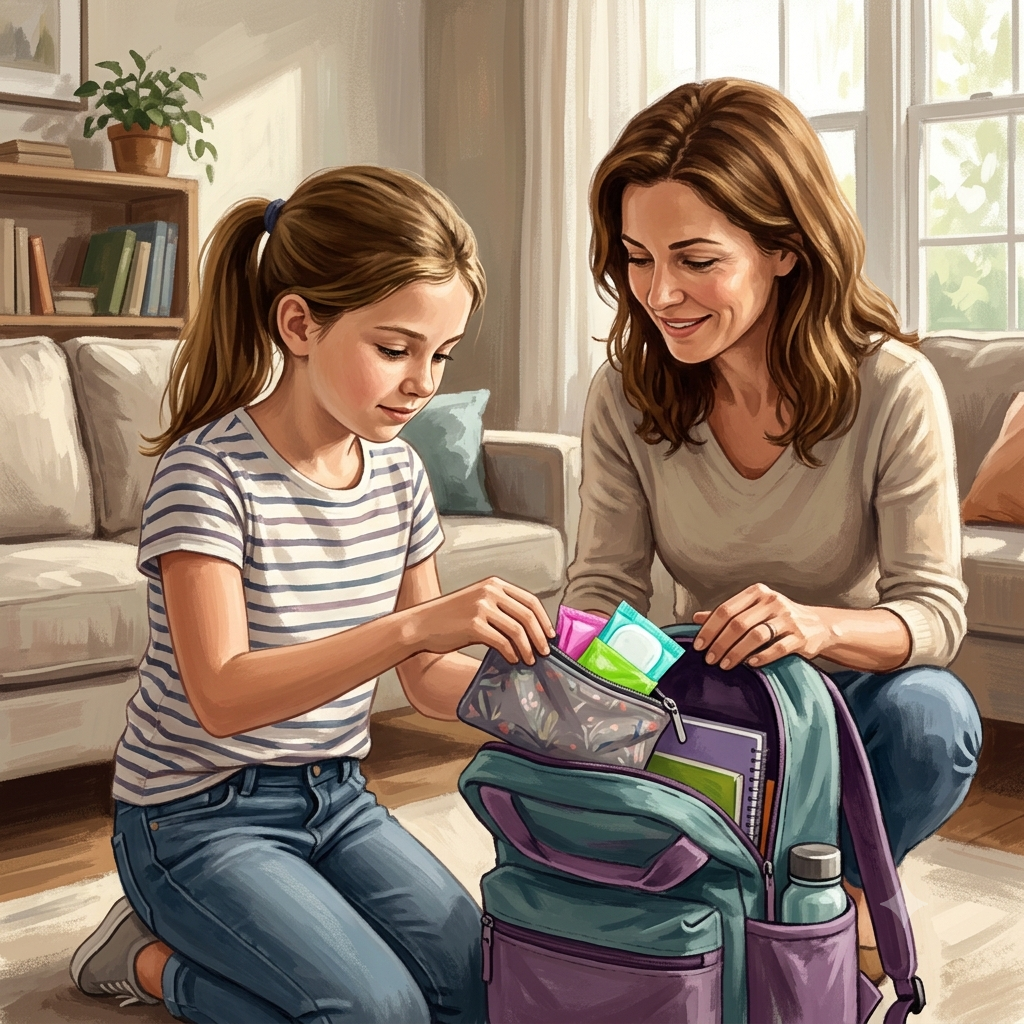
Get her a small kit she can keep in her school bag or locker before she needs it, not after. Walk her through what to do if it starts at school, who she'd tell, where supplies are kept, what the actual steps are. Practical readiness does more for her confidence in the moment than any amount of reassurance delivered in advance.
Tell her explicitly that this is something she can come to you about at any time, including a false alarm, including a question that feels embarrassing. State that plainly rather than assuming she already knows it.
What to Watch For After It Starts
Once her period has started, keep checking in occasionally rather than assuming the conversation is closed. Ask if anything feels off, if the timing seems unpredictable, if she has questions that have come up since. Girls sometimes sit on discomfort or confusion for a long time before mentioning it, especially if the first conversation felt like a one-time event rather than an open topic.
If anything seems medically unusual, extremely heavy bleeding, severe pain that disrupts her day, periods that haven't settled into any pattern after a year or so, that's a conversation for her pediatrician, not something to diagnose or manage at home.
What This Isn't
This isn't a talk that needs to be dressed up as a celebration if that's not genuinely how she or you feel about it. Some girls do want to mark it as significant. Others just want accurate information and to move on with their day. Follow her lead rather than assuming which one she needs.
It also isn't a single conversation that replaces ongoing openness about her body more generally. The period talk works best as one part of a broader pattern where questions about her body get answered plainly and without embarrassment, starting well before puberty and continuing through it.
The Actual Goal
The goal isn't a perfectly delivered speech. It's a daughter who has the facts before she needs them, practical tools ready before the moment arrives, and an open line back to you for whatever comes up after. Get those three things right and the exact wording of the first conversation matters far less than most parents assume going in.
I want to help girls stay connected to their own bodies instead of afraid of them. That starts with accurate information, delivered before the moment it's needed, not after.