
What to Do When Your Daughter Says She Hates Her Body
It comes out of nowhere.
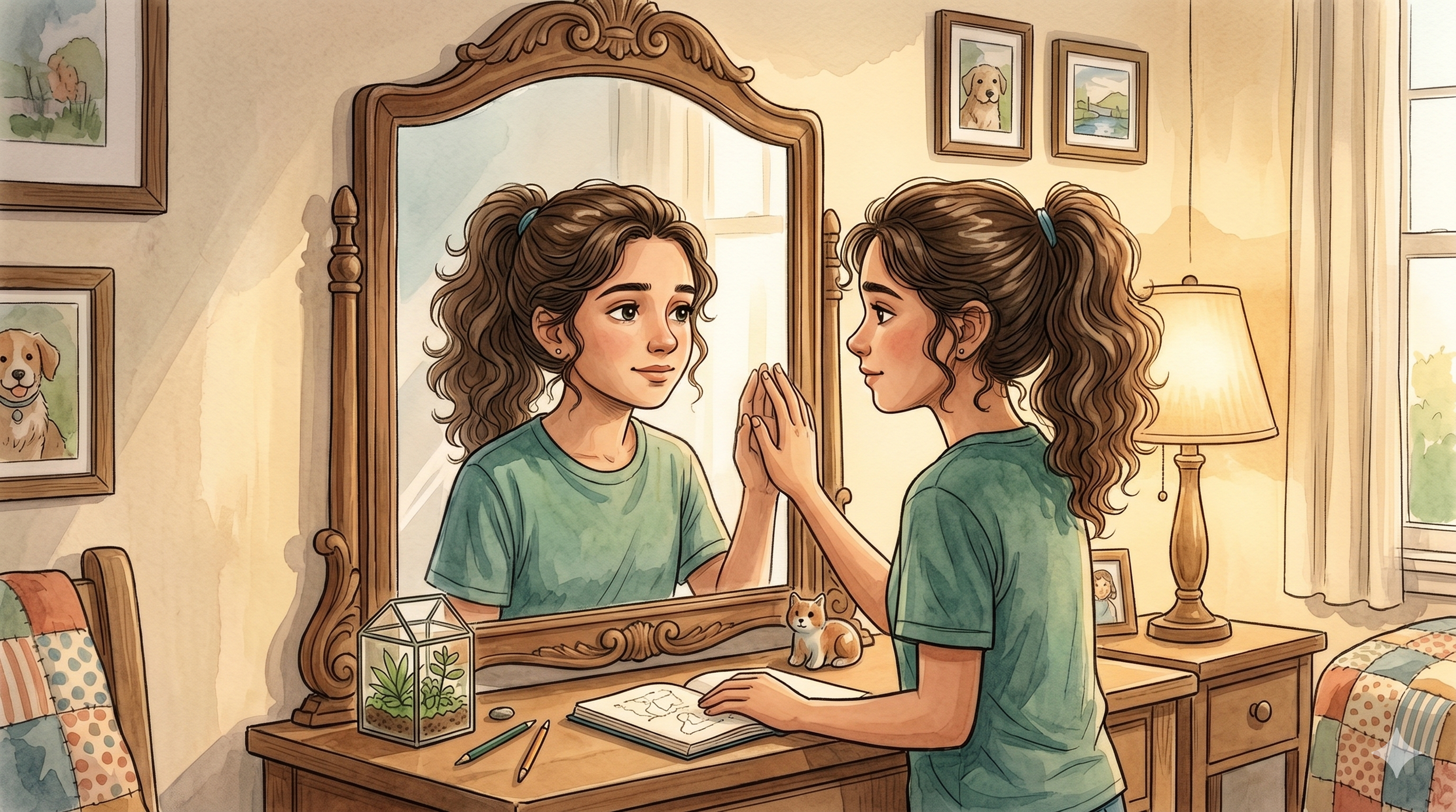
You are getting ready to leave the house. She catches a glimpse of herself in the mirror and says something that stops you cold.
"I look fat."
"I hate my thighs."
"Why do I look like this?"
Your first instinct is to fix it. To tell her she is beautiful. To list every reason she is wrong. To make the feeling go away as fast as it arrived.
But the feeling does not go away. And sometimes, the things parents say in that moment, with the best intentions, make it harder to talk about next time.
Here is what is actually going on, and what to do with it.

Why This Is Happening Now
Body image concerns in girls are not new. But they are arriving earlier than most parents expect.
Research consistently shows that girls begin to express dissatisfaction with their bodies as young as age 6. By the time puberty starts, many girls are already measuring themselves against an internal standard they absorbed from somewhere else.
That standard comes from a lot of places at once.
Social media, even with parental restrictions, finds its way in. Friends talk. Older siblings talk. Comments from relatives at family gatherings land harder than the person who said them ever intended. Magazines in waiting rooms. Filters on apps. Before and after photos that are technically about fitness but are really about the idea that your current body is a problem to be solved.
Your daughter is absorbing all of it and trying to locate herself inside it.
Puberty makes this harder. Her body is changing faster than she can adjust to. Things that fit last month do not fit this month. Curves appear that were not there before. She is in a body that feels unfamiliar, and she is being told by the world around her that bodies like hers are supposed to look a specific way.
The dissatisfaction she is expressing is not vanity.
It is disorientation.
What Not to Say (Even Though It Feels Right)
Most parents respond to "I hate my body" with one of a few instinctive replies.
"You are beautiful. You have nothing to worry about."
"You do not look like that at all."
"I would kill to have your metabolism."
"You should see me. I have way more to complain about than you do."
Every one of these is said with love. And every one of them, in its own way, closes the conversation.
"You are beautiful" tells her that her job is to be beautiful, and that the problem is she cannot see it accurately. It does not address the feeling underneath.
"You do not look like that" invalidates her perception. She does not feel corrected. She feels dismissed. And next time, she will keep it to herself.
"You should see me" shifts the focus to you, and it also introduces the idea that body criticism is a normal way women relate to themselves and each other.
None of these are terrible things to say. But they are deflections. And what she needs is not deflection.
She needs to feel heard first.
What to Say Instead
Start by receiving what she said without reacting to it.
"Tell me more about that."
Or simply: "That sounds like it does not feel good."
You are not agreeing with her assessment of her body. You are acknowledging that she is having a real feeling. That distinction is important, and she will feel the difference.
Once she knows she has been heard, you have more room to work with.
From there, a few directions that tend to help:
Get curious about where it came from.
"Did something happen today that brought that on?" or "Is this something you have been thinking about for a while, or did it just come up?"
Sometimes a specific comment triggered it. A girl at school. A photo she saw. Something someone said without realizing the weight of it. Finding the source does not erase the feeling, but it helps both of you understand what you are actually dealing with.
Talk about what bodies do, not just how they look.
This is not a lecture. It is a reframe, and it works best when it is brief.
"What did your body do today that was kind of amazing? It walked you through a whole school day. It is growing. It is doing things right now you cannot even see."
You are not dismissing her concern about how she looks. You are expanding the frame so that appearance is not the only thing her body is for.
Be honest about your own relationship with your body, carefully.
If you have struggled with body image, you do not have to pretend you have not. But be selective about what you share and when.
"I know what it feels like to look in the mirror and not love what you see. I have been there. And I have learned some things about how to handle that feeling."
That honesty builds connection. What you want to avoid is modeling ongoing dissatisfaction. If she regularly hears you criticize your own body, she learns that this is what women do. That message outweighs almost anything else you say directly to her.
The Comment That Came From a Relative
This one deserves its own section because it comes up constantly.
A grandparent says something at Easter dinner. An aunt comments on how much she has "filled out." A cousin makes a joke that is not actually a joke.
Your daughter goes quiet. You catch it. And then you have to decide what to do.
First, in the moment: a simple redirect is enough.
"She is doing great. Growing up looks good on her."
You do not need to cause a scene. You just need her to see that you noticed and you said something. That alone tells her more than a long conversation later would.
After, privately with her: "I heard what was said. That was not an okay thing to say, and it is not true. I want you to know that."
And then leave space for her to respond or not.
What you do not want is for her to absorb that comment in silence and assume it carries some kind of truth because no one pushed back.
Your voice in that moment is louder than the original comment.
Use it.

When It Is More Than a Hard Moment
Most girls will say something negative about their body at some point during the tween years.
That is not a crisis. It is a signal worth paying attention to.
But there are signs that what you are seeing goes beyond normal developmental frustration and warrants a closer look.
Watch for these patterns:
She is consistently refusing meals, restricting what she eats, or showing significant anxiety around food. She talks about her body in a way that is persistent and severe rather than occasional and passing. She avoids social situations because of how she feels about her appearance. She is comparing herself obsessively and it is affecting her mood for days at a time.
If you are seeing more than one of these, trust your instinct.
Talk to her pediatrician. Ask specifically about body image and eating. You do not need to have a diagnosis to raise the concern.
Catching something early is always better than waiting for certainty that never quite arrives.
What You Are Actually Building
Every time you handle one of these moments well, you are doing something that compounds over time.
You are becoming the person she brings things to.
Not just the easy things. The hard things. The shameful things. The things she is not sure she should say out loud.
Girls who grow up feeling that their bodies are something to be ashamed of, or that their appearance is their most important quality, carry that with them. It shows up in relationships, in how they take care of themselves, in how they speak to their own daughters one day.
Girls who grow up hearing from a trusted adult that their body is capable and worthy and not a problem to be solved, those girls build something different.
You are laying that foundation right now, in ordinary moments.
When she says something unkind about herself and you stay calm.
When you ask a question instead of giving an answer.
When you make it clear that she can come back to you with this tomorrow, and the day after, and every time it comes up.
That is the work.
It does not feel dramatic. It does not feel like enough.
But it is exactly enough.