
When She Stops Telling You Everything
There was a time when she told you about every part of her day.
Who said what at lunch. What happened at recess. The funny thing the teacher did. The drama that started on the bus and resolved before dinner.
You did not have to ask. It just came.
And now it does not.
Now you ask how her day was and she says fine. You ask what happened at school and she says nothing. You try a different angle and she gives you a look that makes you feel like you just asked something unreasonable.
You wonder if she is upset with you. You wonder if something happened that she is not telling you. You wonder when exactly this shift occurred and whether you missed a moment when you could have prevented it.
You did not miss anything.
This is not a rupture.
This is development, doing exactly what it is supposed to do.

What Changes, and What Does Not
Here is what actually shifts during this phase.
She becomes more selective about what she shares. The information that used to flow freely now gets filtered. Some of it she keeps because it feels private. Some of it she keeps because she is still processing it. Some of it she keeps because she wants to handle it herself before anyone else weighs in.
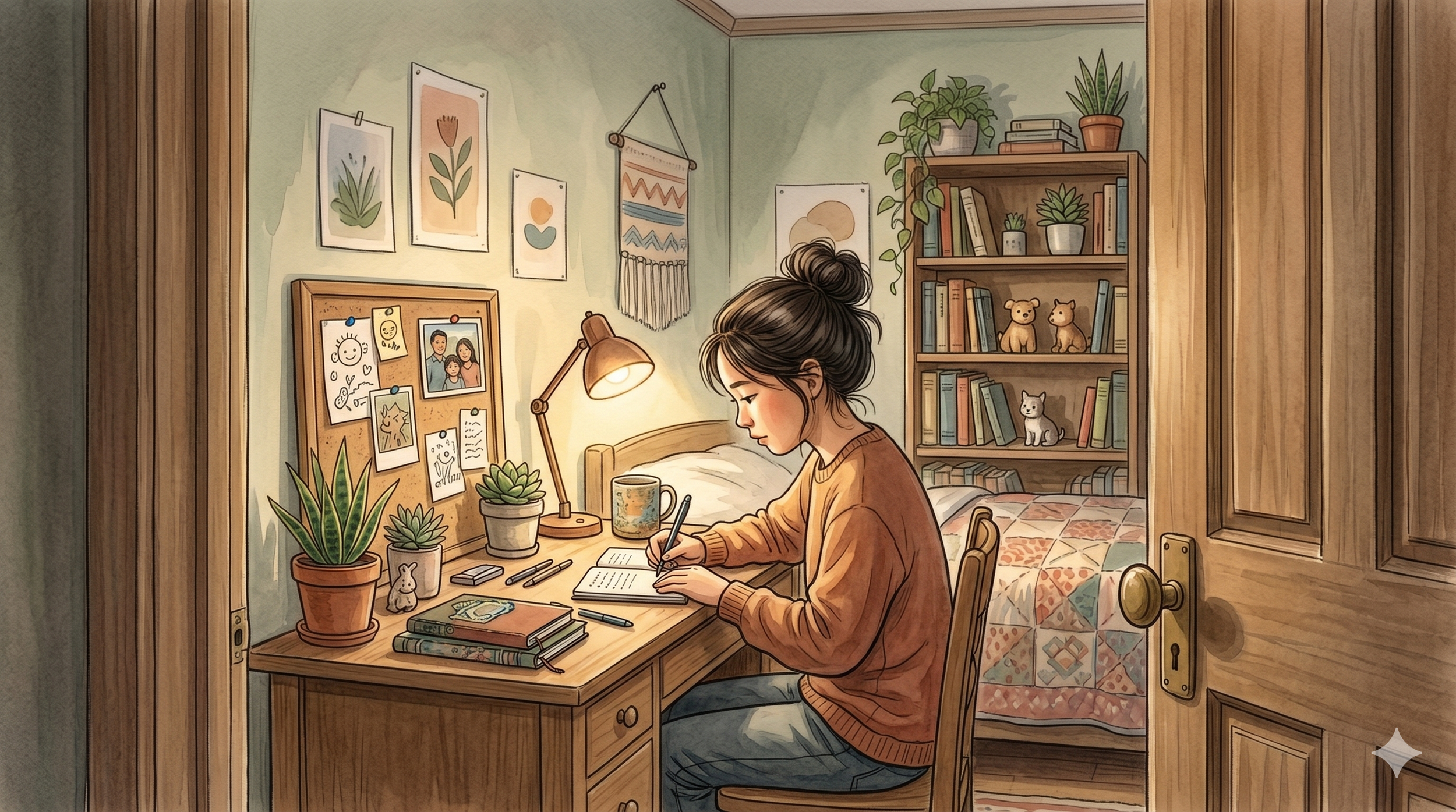
She develops stronger opinions about her own space. Her room becomes more important. Her time feels more personal. She may want to know that she can be alone without you checking in every twenty minutes.
She starts caring more about what her peers think than what you think. This is uncomfortable to watch. It is also developmentally right on schedule. The peer group becomes her primary reference point for a while. Your influence does not disappear. It just operates more quietly.
Here is what does not change.
She still needs you.
Not in the same way. Not for the same things. But the need is there, underneath the closed door and the one-word answers.
She needs to know that your relationship can survive her becoming more independent. That you will not take the distance personally. That home is still a place she can return to fully, whenever she needs to, without having to earn her way back.
Why She Is Pulling Away
The move toward privacy is not a rejection of you.
It is a developmental task.
Between the ages of 9 and 13, something fundamental shifts in how girls understand themselves. They begin to separate their inner world from the people around them, including and especially the people they are closest to. They start to develop a self that is distinctly theirs. Opinions you did not give her. Preferences that surprise you. A version of herself she is constructing without your input.
This is healthy.
A girl who never pulls away, who never develops a private interior life, who always tells her parents everything without filter, is actually missing something important in her development.
The pulling away is her practicing being a separate person. It is uncomfortable for parents. It is necessary for her.
Psychologists describe this process as individuation. It is the same thing that happens in toddlerhood, when a two-year-old starts saying no to everything not out of defiance but out of an emerging sense of self. The tween version is quieter, but it runs on the same engine.
She is not leaving you.
She is becoming herself.
The Mistakes Parents Make Without Knowing It
When a child pulls back, parents often respond by pressing in.
More questions. More check-ins. More attempts to recreate the closeness that used to feel effortless.
The instinct makes sense. You miss her. You are worried. You want to know she is okay.
But pressing in when she is pulling back usually produces the opposite of what you want.
She reads the extra questions as surveillance. The frequent check-ins as distrust. The attempts at forced conversation as pressure she does not have the bandwidth for.
And so she pulls back further.
A few specific patterns worth watching in yourself:
Interrogating instead of inviting.
There is a difference between "How was your day, anything interesting happen, did you talk to that girl you mentioned, how did the test go" and "How was your day?" followed by genuine silence. One is a questionnaire. One is an open door.
Making her withdrawal about your feelings.
"You never talk to me anymore" and "I feel like I do not know what is going on in your life" are true statements that put her in the position of managing your emotions. She is not equipped for that right now and it often creates guilt that pushes her further away, not closer.
Using connection as surveillance.
If every attempt to talk feels to her like you are checking up on her, monitoring her, or looking for something to correct, she will stop talking. Connection and oversight are not the same thing and she can feel the difference.
Comparing now to before.
"You used to tell me everything" is a way of letting her know that who she is becoming is less than who she was. Even if that is not what you mean, that is often what she hears.
How to Stay Close Without Holding On Too Tight
The relationship does not have to shrink just because she is changing.
It has to change shape.
Find the side door.
Most tween girls do not open up in direct, face-to-face conversations. They open up sideways. In the car, when no one is making eye contact. While doing something else, so the conversation is not the main event. While walking the dog, cooking together, watching something side by side.
Stop trying to create the conversation. Create the conditions and let it happen on its own schedule.
Stay interested without being intrusive.
There is a version of interest that feels like care and a version that feels like monitoring. The difference is often in the questions.
"Is there anything going on I should know about?" feels like monitoring.
"I was thinking about you today. Just wanted you to know." feels like care.
One requires her to report. One just tells her she is on your mind.
Let some silences be okay.
You do not need to fill every quiet moment with conversation. Sitting together without talking is still connection. Doing something alongside each other, even without exchanging words, is still presence. She notices that you are there even when nothing is being said.
Be consistent and undemanding.
Show up at the same times, in the same ways, without attaching conditions to it. Make dinner. Drive her where she needs to go. Be physically present without requiring her to perform closeness in return.
The consistency is the message. It tells her that you are still there, still interested, still her parent, regardless of how much she gives you back right now.

When She Does Open Up, Do Not Blow It
This is the part that matters more than anything else in this post.
There will be moments when the door opens.
She mentions something in passing that sounds like it matters. She starts a sentence that feels bigger than the end of it. She asks you something that sounds casual but is probably not.
These moments are fragile.
What you do in the next sixty seconds determines whether she keeps going or stops.
Do not overreact. If she says something that surprises you, keep your face and your voice steady. A strong reaction, even a positive one, can be enough to make her pull back.
Do not interrupt. Let her finish. All the way. Even if you already know what you want to say.
Do not pivot to advice immediately. Ask one question first. "What was that like for you?" or "How are you feeling about it?" shows her that you want to understand before you want to solve.
Do not make it a bigger moment than she brought. If she mentioned something small, treat it as small, even if it does not feel that way to you. Match her energy. Let her calibrate how much this conversation grows.
She is testing the waters every time she opens up.
Pass the test enough times and she will come back to the water more often.
The Long View
This phase does not last forever.
Most women, when they reach their twenties, describe coming back to their mothers in a new way. Not the same way as childhood, but something richer. Built on the fact that the relationship survived the years when everything felt complicated.
What makes that possible is what you do right now.
Not perfectly. Not without frustration. But with enough steadiness that she knows the door between you stays open from your side, even when she needs to keep hers closed for a while.
She is not going away.
She is going inward.
And when she is ready to come back out, you want to be the person she finds waiting. Calm, consistent, not resentful of the time it took.
That is the whole job in this season.
It is harder than it sounds.
It is also more than enough.