
Why Tween Girls Get Irritated When Puberty Comes Up
Your daughter may ask you for a snack, tell you a detailed story about something that happened at lunch, show you a bruise on her shin, and then act personally offended when you mention deodorant. The shift can be fast. One minute she is standing close enough that you can smell the cafeteria fries on her sweatshirt. The next minute she is backing away like you announced her puberty symptoms through a microphone.
A lot of parents misread that reaction. They think irritation means the topic is off-limits. They think the eye roll means their daughter does not want information. They think the sharp “I know” means she already understands more than she does. Sometimes she does know. Sometimes she does not. And sometimes she is not reacting to the information. She is reacting to being seen.
That distinction matters.
Puberty does not arrive as one tidy family discussion. It often shows up sideways. A sports bra in the laundry. A deodorant stick left uncapped on the bathroom counter. A sudden refusal to wear a shirt she liked two weeks ago. A girl standing in front of the mirror, adjusting the same ponytail four times, then snapping when someone asks what is wrong.
Parents often want to respond to the change directly because they are trying to be helpful. She often experiences the directness as exposure. That is where irritation enters.
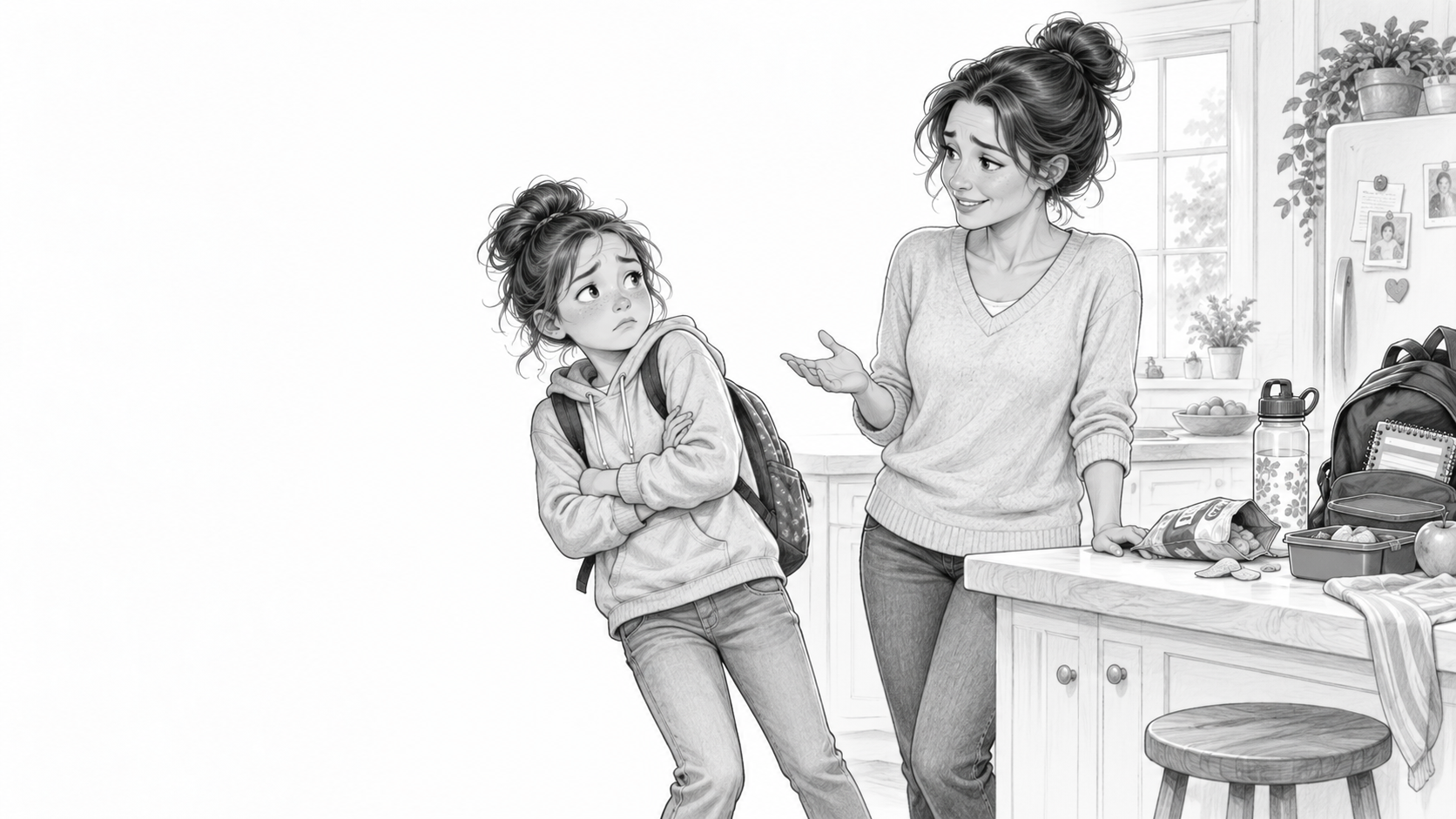
Irritation is often embarrassment with armor on
A tween girl may not say, “I feel embarrassed that my body is changing and I do not know how to act normal while you are noticing it.” She may say, “Stop.” She may say, “You are being weird.” She may say, “Why do you care?” She may say nothing and leave the room with the energy of someone who has been deeply wronged by a sentence about shampoo.
The behavior looks like disrespect. Underneath, it may be discomfort. That does not mean parents should accept rude behavior without limits. It means the first job is interpretation.
When a girl gets irritated during puberty talk, ask yourself what happened right before the reaction. Was her body named? Was a smell noticed? Was a bra, period product, pimple, or body shape mentioned in a shared space? Was a sibling nearby? Was the topic brought up at a time when she could not leave easily, like in the car, at dinner, or while getting ready for school?
Those details matter because puberty makes ordinary moments feel newly public. A comment that sounds neutral to an adult can feel exposing to a girl who is still learning how to live inside a changing body.
A parent may say, “You need to start wearing deodorant every day.” A daughter may hear, “Everyone can tell something is wrong with me.” A parent may say, “Do you need more period products in your backpack?” A daughter may hear, “My body is now a household topic.” A parent may say, “That shirt looks tight.” A daughter may hear, “People are watching my body.”
The parent is solving a practical problem. The girl is managing a new kind of self-consciousness.
Those two things collide.
The “I know” response does not always mean she knows
Tween girls use “I know” for many reasons.
Sometimes it means, “I already learned this.” Sometimes it means, “Please stop talking before I get more embarrassed.” Sometimes it means, “I understand enough to not want more details right now.” Sometimes it means, “I want to seem older than I feel.”
That last one matters.
Puberty can make a girl feel behind and too grown at the same time. She may want privacy, but still need help. She may want independence, but still need you to buy the deodorant, explain the discharge in her underwear, or remind her that period blood can be brown, red, or pink.
This contradiction can frustrate parents because it looks inconsistent.
She wants the door closed, but wants you nearby. She says she does not care, but keeps checking the mirror. She refuses help, then gets upset when she feels unprepared. That is not always manipulation or attitude. Often, it is a girl trying to protect her dignity while still needing support.
Parents can make this easier by not turning every puberty moment into a formal sit-down. A formal sit-down can feel like too much attention placed on one body, one question, one smell, one stain, one change. Sometimes the better approach is smaller and calmer. “You are at the age where deodorant becomes part of the morning routine. I put one in your bathroom drawer.” That sentence gives information without turning her into the topic. “Period products are in the small pouch in your backpack. You do not have to use them today. They are there so you are not stuck without one.” That sentence prepares without demanding an emotional response. “Bodies change at different times. If something feels confusing, you can ask me. I will answer plainly.” That sentence leaves a door open without standing in the doorway waiting for her to walk through it.

Privacy is not secrecy
Many parents get nervous when their daughter starts wanting more privacy. The closed bathroom door feels different. The bedroom door stays shut longer. Laundry gets pulled from the dryer faster. A stained pair of underwear may disappear into the trash before anyone can explain what happened.
Privacy can look like distance, especially when a child who used to announce every thought now gives one-word answers. But privacy is not always rejection. Privacy is often a girl trying to sort out what belongs to her.
Her body is becoming more noticeable to her. Sometimes to others. She may not have the emotional language to separate privacy from shame yet. This is where parents can accidentally make things heavier.
If every private behavior gets chased with questions, privacy starts feeling unsafe. “Why are you hiding that?” “What happened?” “Are you embarrassed?” “Why did you not tell me?” Those questions may come from care, but they can land like interrogation.
A calmer approach is to name the practical thing without forcing confession. “I saw the underwear in the trash. That can happen before or during a first period. I put a few clean pairs and period products in your drawer. Nothing is wrong. You can ask me questions when you are ready.”
Then stop talking.
Many parents keep explaining because silence makes them nervous. They want to make sure their daughter feels okay. They want to repair awkwardness quickly. They want to prove they are available. But a tween girl may need space to absorb the information without performing comfort back to the adult. She may need to act annoyed and then quietly use the supplies later.
That still counts.
Do not confuse calm with casual
Puberty deserves clear language. It does not need a dramatic tone. Some parents swing too far in one direction. They either treat puberty like a secret emergency, or they act so casual that their daughter’s discomfort gets missed. A girl can feel embarrassed even when nothing bad is happening. A girl can need direct information even when she says she does not want to talk. A girl can be irritated and still be listening. Calm does not mean pretending the moment has no weight. Calm means you are steady enough not to make your daughter carry your discomfort too.
That is especially true with body image.
A daughter may not talk about comparison directly. She may ask if her legs look weird in shorts. She may refuse to swim. She may delete every photo where her stomach shows. She may suddenly hate jeans, even though the jeans still fit. The behavior matters.
Do not rush to say, “You look fine.” That answer is quick, but it often misses the question underneath. She may not be asking whether she looks fine. She may be asking whether her changing body is still acceptable. She may be asking whether other people are noticing. She may be asking whether comparison is about to become the new rule. A steadier answer sounds more specific. “I can tell those shorts feel different on you today. Bodies can feel unfamiliar during puberty, even when nothing is wrong. You do not have to decide your whole opinion of your body from one mirror moment.” That answer names the behavior, interprets the discomfort, and gives her a little room.
It does not argue with her perception. It does not praise her into silence. It does not turn her body into a debate.
What to say when she snaps
When your daughter snaps, the first instinct may be to correct the tone immediately. Sometimes that correction is needed. But if you only correct the tone, you may miss the reason the tone appeared.
A practical sequence helps.
First, pause. Do not match the sharpness.
Second, name the boundary. “You can be embarrassed. You cannot speak to me like that.”
Third, reduce the spotlight. “I am not going to keep talking about this in the kitchen.”
Fourth, give the useful information plainly. “Deodorant is in your drawer. Use it before school and after sports.”
That is enough. The goal is not to win the puberty moment. The goal is to keep the topic speakable. If every puberty topic becomes a fight about attitude, the body change gets buried under conflict. Then a girl learns that puberty talk leads to tension, correction, and embarrassment.
She may still need the information, but now she has to climb over the emotional mess to get it. Parents can lower that barrier. Not by becoming permissive. By staying steady.

Your discomfort teaches too
Daughters listen to more than direct instruction. They notice whether adults whisper the word period. They notice whether body changes are treated like problems. They notice whether a parent looks panicked while trying to sound relaxed. They notice whether the adult can say vulva, discharge, period blood, bra, sweat, body hair, and acne without acting like the words have to be smuggled across the room. This does not mean every parent has to become perfectly comfortable overnight.
It means your steadiness matters.
If you grew up with shame around puberty, you may feel awkward naming things directly. If your own body was criticized, you may feel clumsy helping your daughter build a different pattern. If nobody explained much to you, you may feel unprepared for how many small questions puberty creates. That history is real. But your daughter should not have to inherit every silence that was handed to you.
You can start with plain language. “You may notice more discharge in your underwear. That can be part of puberty.” “Period blood is not always bright red.” “Sweat can smell stronger during puberty, so deodorant becomes part of taking care of your body.” “Breasts can feel sore as they grow.” “Body hair may show up before you feel ready for it.”
These sentences are not fancy. That is why they work. They make the body understandable.
The goal is not one perfect talk
A lot of parents put too much pressure on one puberty talk. They wait for the right time. Then the moment comes, the child looks horrified, the parent gets nervous, and both people leave feeling like something went wrong.
Puberty is better handled in small, repeated moments. A sentence in the laundry room. A note next to a period pouch. A calm answer in the car.
A daughter does not need every detail at once. She needs to know that body changes can be talked about without panic, teasing, lectures, or performance. That trust builds slowly. It builds when you do not make her embarrassment the center of the room. It builds when you answer the actual question instead of rushing into a speech. It builds when you give her privacy without turning privacy into suspicion. A girl can roll her eyes and still feel relieved that you knew what to do. She may not say that part out loud. You may see it later when the deodorant gets used. When the period pouch disappears into her backpack. When she asks one question while pretending she barely cares about the answer.
That is often how trust looks at this age. Not dramatic closeness. A girl who can stay near the information without feeling swallowed by it.