
How to Help Your Daughter Prepare for Her First Period Without Making It Weird
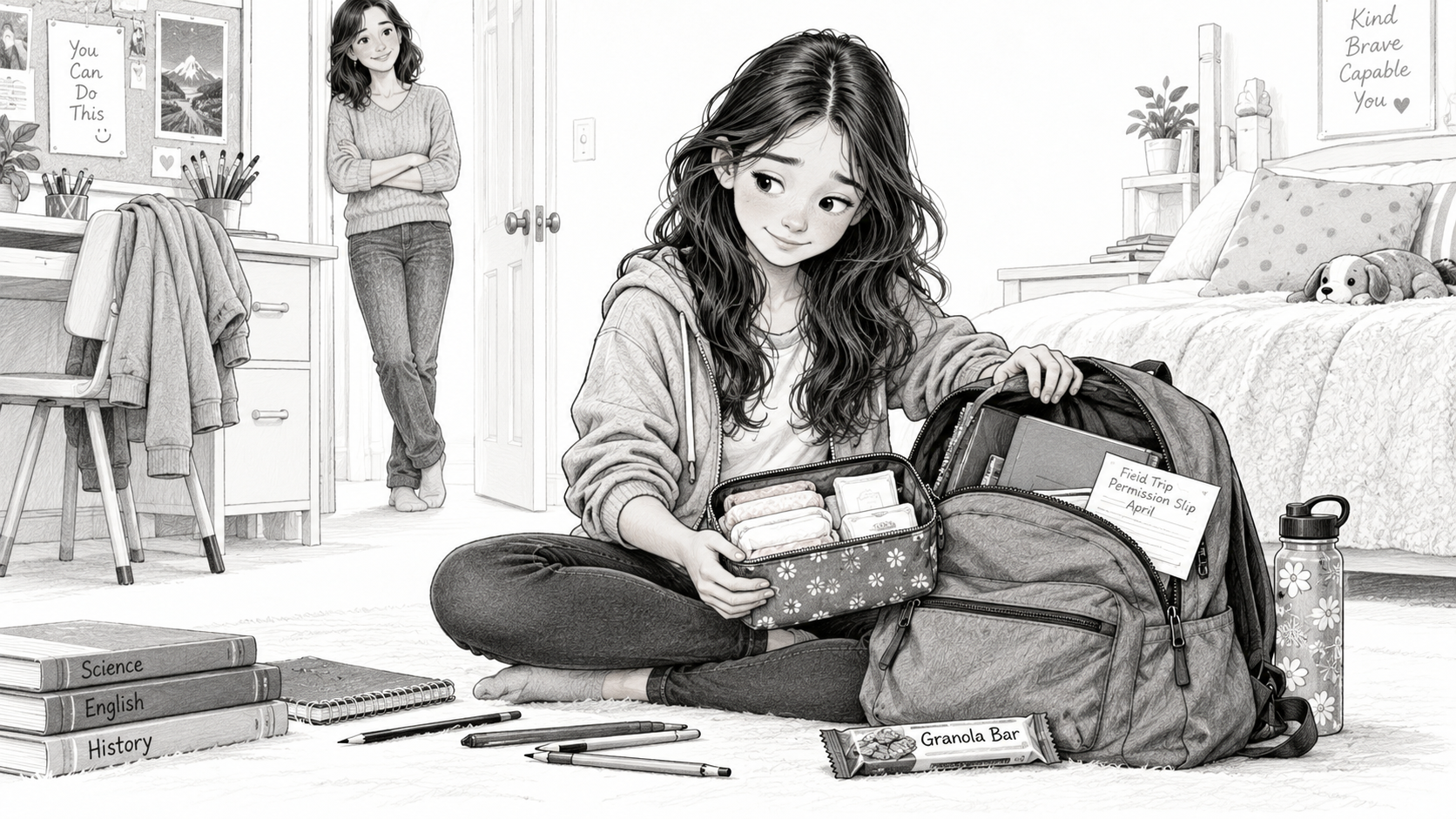
A first period kit can become oddly dramatic in the hands of a tween girl. Not because the kit is dramatic. Because the rectangle is detectable. She may reorganize the pouch three times, ask why the pad wrapper is so loud, hide it under pencils, a granola bar, and a crumpled permission slip from April, then insist she does not need it. Later, she may quietly check that it is still there.
That contradiction matters. A girl can reject the preparation and still feel safer because it exists. She can act annoyed by the conversation and still remember every word. She can say she already knows, while also hoping you tell her exactly what to do if blood shows up at school.
That is why first period preparation works best when it is practical, plain, and not emotionally oversized. Parents often want to make the moment warm. They want to say the right thing. They want their daughter to feel positive about her body. Some are also trying to repair what they did not receive when they were younger. That instinct is understandable, but a tween girl may not want a ceremony. She may not want a long talk. She may not want her changing body turned into a family milestone. She may want supplies, privacy, accurate information, and a parent who does not look scared.
Start Before There Is Blood
Many girls hear about periods before they get one, but hearing the word period is not the same as knowing what to do. A girl may know periods exist and still panic when she sees brown discharge in her underwear. She may know pads are used for bleeding and still have no idea which side sticks to the underwear. She may know periods usually happen around once a month and still think something is wrong when the first few cycles do not follow a neat schedule. Knowing the category is different from understanding the situation.
Preparation should happen before the first period starts, but it does not have to happen through one heavy talk at the kitchen table. It does not need to be a surprise lecture in the car when she cannot leave. It should not wait until a stain appears and everyone is tense. Start with the practical frame: “At some point, your period will start. It may happen soon, or it may not happen for a while. I want you to know what to do so you are not trying to figure it out in a bathroom stall at school.”
That sentence gives her the reason without asking her to feel excited. It does not make her body a performance. It does not make the parent’s emotion the center. From there, show her the supplies in a direct way. “This is a pad. This part sticks to your underwear. This part faces your body. If blood gets on your underwear, wrap the underwear in toilet paper or put it in a bag, and tell me when you can. You will not be in trouble.”
A lot of girls need that last sentence. Not because they think menstruation is wrong in a logical way, but because blood, stains, smell, and school bathrooms can make the body feel suddenly unmanageable. Clear instructions reduce panic. They also prevent a girl from pretending nothing happened because she is afraid of being corrected, teased, or exposed.
Use Correct Words Without Making Them Heavy
Period language does not need to be whispered, but it also does not need a big emotional tone. Use the words plainly: period, menstrual cycle, pad, tampon, period underwear, vulva, vagina, uterus, discharge, blood. This content is educational and does not replace medical advice from your daughter’s clinician. If she has severe pain, very heavy bleeding, bleeding that worries you, symptoms that interfere with daily life, or questions about what is typical for her body, talk with a pediatrician or another qualified medical professional.
The point of clear language is not to sound clinical. The point is to reduce confusion. Euphemisms can make girls feel like the body is too embarrassing to name. They also make it harder to ask precise questions. A girl who has only heard vague phrases may not know how to explain what she is seeing. She may say, “Something weird is happening,” when she means discharge. She may say, “It hurts,” when she means cramps, vulva irritation, or soreness near her lower abdomen. The words help. But the tone matters too. A parent can use correct words and still make the moment feel loaded if every sentence sounds nervous.
A steady tone teaches something the words cannot. This is a body change. It can be understood. It can be handled. It does not require panic.
Build the First Period Kit for Real School Life
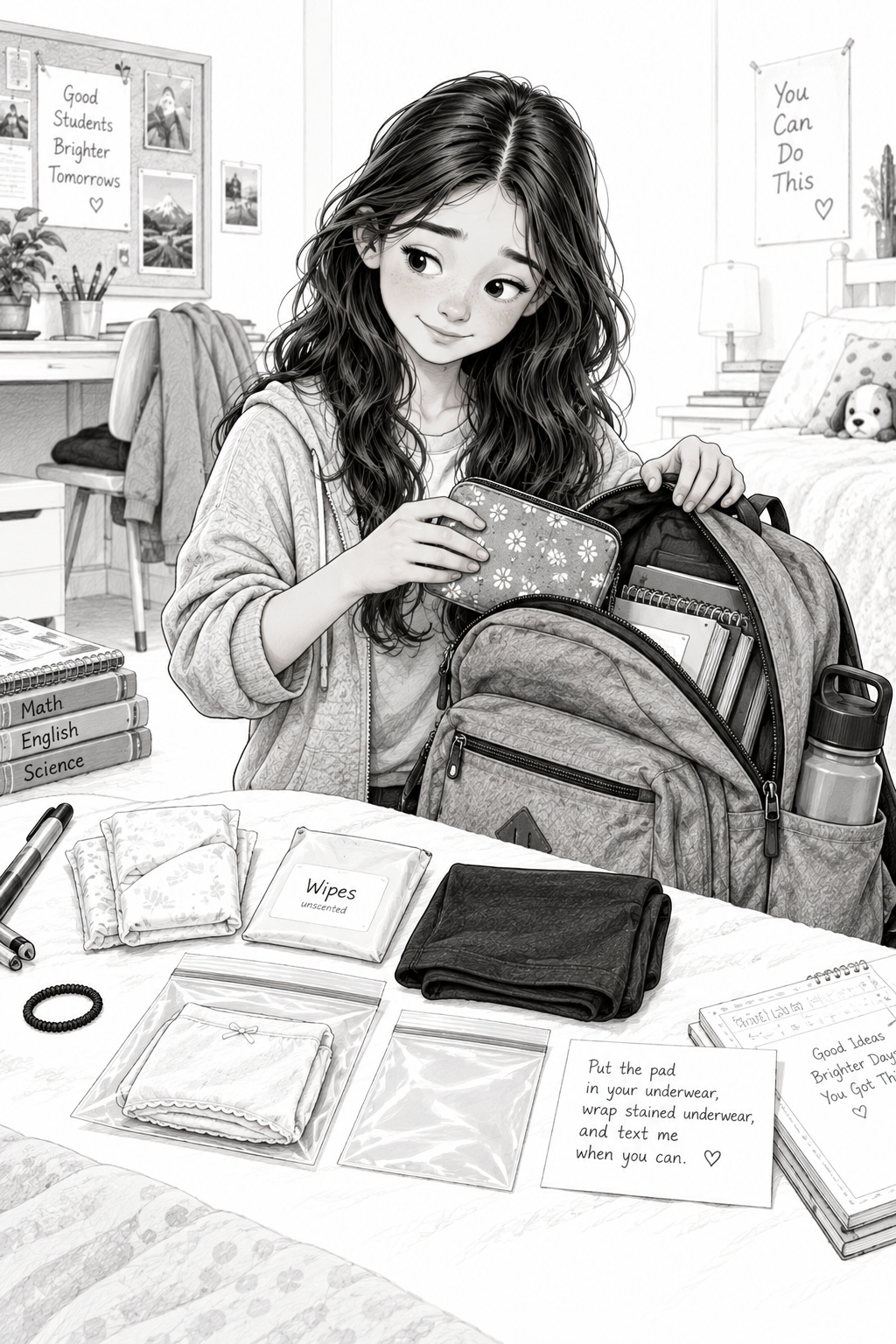
When you build a first period kit, build it for actual school life. Some kits look tidy at home and fail the moment they enter a backpack. The pouch is too obvious. The products are too bulky. The zipper gets stuck. The pad wrapper sounds like someone opening chips in a silent classroom. The bag gets buried under markers, old worksheets, and one suspiciously sticky hair tie. A useful kit should be small enough to carry without announcing itself and simple enough to use when she is embarrassed.
For many girls, that means one or two pads that fit her underwear, a clean pair of underwear in a small bag, a dark pair of leggings or shorts if her school bag has room, a small pack of unscented wipes, a sealable bag for stained underwear, and a short note with the steps. The note does not have to be sentimental. It can say, “Put the pad in your underwear, wrap stained underwear, and text me when you can.” That note may seem unnecessary, but embarrassment can make simple steps harder to remember. Especially at school. Especially if there is blood. Especially if she is worried someone will see the pad in her hand.
Do not overpack the kit unless she wants that. A giant pouch can make the whole thing feel more obvious. The goal is not to prepare for every possible period situation. The goal is to give her enough to get through the first moment without feeling trapped. Let her help choose where the kit goes. She may pick a front pocket, bury it deep, want one in her backpack and one in her sports bag, or ask for a pouch that looks like a pencil case. That choice gives her some control without making her responsible for everything.
Tell Her What Period Blood May Look Like
It helps to tell her what period blood may actually look like before she sees it. Many girls expect first period blood to look bright red. Then they see brown or rust-colored staining and feel confused. Say it plainly: “Period blood can be red, brown, pink, or darker at different times. Brown blood is often older blood leaving the body. If you see that in your underwear, you can tell me or use the supplies in your kit.”
Explain amount too. “Your first period may be light. It might look like spots. It may not be a lot of blood at first.” A girl who expects dramatic bleeding may miss early signs. A girl who sees a small stain may think it does not count. A girl who sees blood once and then not again for a while may think something is wrong. Keep the explanation simple. Early periods can be irregular. Bodies do not always follow a calendar right away. Tracking the dates can help her notice patterns over time, but tracking should not become a surveillance system.
A parent does not need to inspect every cycle unless there is a medical concern. A girl can mark it on a calendar, use a paper tracker, or write the date somewhere private. Some girls like apps later, but many younger girls do better with something simpler and less connected to a phone. The goal is awareness, not monitoring every detail of her body like a report.
Prepare for the School Bathroom Problem
The school bathroom problem deserves its own preparation. Adults sometimes forget how exposed a school bathroom can feel. The gaps in the stalls. The broken lock. The friend waiting outside. The pad wrapper noise. The fear that blood went through her pants. The math worksheet she is now supposed to return to like nothing happened. A first period at school is not only about bleeding. It is about managing a body change in a place where privacy is limited and embarrassment travels fast.
Give her a school plan before she needs it. “If your period starts at school, go to the bathroom. Use the pad from your pouch. If your underwear is stained, put it in the bag. If your pants are stained, tie a sweatshirt around your waist if you have one, then go to the nurse or office. You can text me from there.” If your daughter does not have a phone, give her another option: “Ask to go to the nurse. You can say, ‘I need help with my period.’ You do not have to explain it to the whole class.”
That sentence matters because girls need actual words when they are embarrassed. Not a long script. Not a speech. One usable sentence. You can also ask the school what support is available. Some school nurses have period products. Some teachers keep supplies. Some offices have extra clothes. Knowing the answer helps you give your daughter a plan that matches her real school.
Expect Resistance Without Treating It as Failure
Do not assume she will ask for help easily. Many girls would rather sit uncomfortably than announce a period problem to an adult they barely know. That does not mean they are being difficult. It means embarrassment can overpower common sense. Preparation lowers the chances that embarrassment gets to make every decision.
Your daughter may not respond with gratitude when you prepare her. She may shrug, say “I already know,” refuse to look at the pad demonstration, or act irritated that the kit exists. That does not mean the preparation failed. A lot of puberty support works quietly. She may reject the conversation and still remember where the pouch is. She may roll her eyes and still feel relieved that you explained brown blood. She may pretend she was not listening and then ask a question two days later while staring into the refrigerator.
That is a very tween way to ask for help. Do not demand the perfect emotional response. Parents sometimes want reassurance that they handled the moment well. They want their daughter to say, “Thanks, that helped.” But many tween girls cannot give that response while also protecting their dignity. Let the information land imperfectly. You can say, “You do not have to talk about it right now. I wanted you to know where everything is.” Then leave it alone. That last part is often the hardest, but if you keep pressing, the topic starts feeling less like support and more like being cornered.

Keep Siblings and Relatives Out of It
A first period should not become a family announcement. Siblings do not need to know. Grandparents do not need a phone call. The story does not need to be retold as a sweet memory while your daughter stands there with a frozen smile. Some parents share because they are moved. Some share because they are proud. Some share because their own families treated these moments openly and they assume openness is always good. But openness without consent can feel like exposure.
Assume privacy by default. If she wants someone to know, she can decide that. This is one of the ways parents teach body boundaries without making a speech about body boundaries. They show, through behavior, that her body is not casual family content. That lesson reaches farther than the first period.
Watch the Body Comments She Hears at Home
First period preparation often happens during the same years when girls become more aware of body size, shape, smell, skin, and comparison. A girl may be learning how to manage pads while also hearing adults criticize their stomachs in photos, talk about needing to earn dessert, or describe their bodies like problems to be fixed. She absorbs more than period information. She learns what kind of body language is allowed in the house.
If the adults around her treat bodies as constant projects, she may start doing the same. If every mirror moment becomes criticism, she may learn that self-evaluation is part of growing up. If puberty is explained clearly but body shame is modeled daily, the clearer lesson may come from the behavior she sees most often. This does not require parents to speak perfectly about themselves. It does require awareness. A daughter hears the casual comments. “My thighs look awful.” “I hate this picture.” “I look disgusting today.” “I cannot wear that until I lose weight.” Those sentences may feel like throwaway adult comments. To a girl entering puberty, they can become instructions.
She is already learning that her body is changing. She does not need to learn that every change must be judged.
Respond Calmly When Her First Period Starts
When her first period begins, match your response to her temperament. Some girls want comfort. Some want information. Some want everyone to act normal. Some want supplies handed through a cracked bathroom door with no eye contact. Respect the child in front of you. A calm response might sound like this: “Okay. You are alright. Put this pad in your underwear with the sticky side down. I put clean underwear outside the door. When you are ready, put the stained pair in this bag. We can talk after, or we do not have to.”
That gives help without turning the moment into a scene. Later, when she is calmer, ask one practical question: “Do you want me to show you again how to use the pad, or did you figure it out?” Not ten questions. One. Then another useful sentence: “We will write down today’s date so you have a record of when it started.”
If she has pain, feels faint, bleeds very heavily, or something seems medically concerning, contact a qualified medical professional. Keep the tone calm while you do it. A parent can take symptoms seriously without frightening the child.
The Real Preparation Is Steadiness
A first period kit matters. So does accurate information. But the deeper preparation is the atmosphere around the body. Can her body be talked about plainly? Can she ask an awkward question without being teased? Can she be embarrassed without the parent becoming embarrassed too? Can she need help and still keep some dignity?
That is what girls remember, even if they do not name it that way. They remember whether the adult panicked. They remember whether the adult told everyone. They remember whether the adult made the moment too precious, too funny, too awkward, or too public. They also remember when someone handled it calmly.
The pad appeared. The underwear got washed. The question was answered. The body made sense again.
That kind of support is quiet, practical, and steady. For a tween girl standing in a bathroom with blood in her underwear, steady is not small.