
Why Your Tween Daughter Suddenly Cares So Much About How She Looks
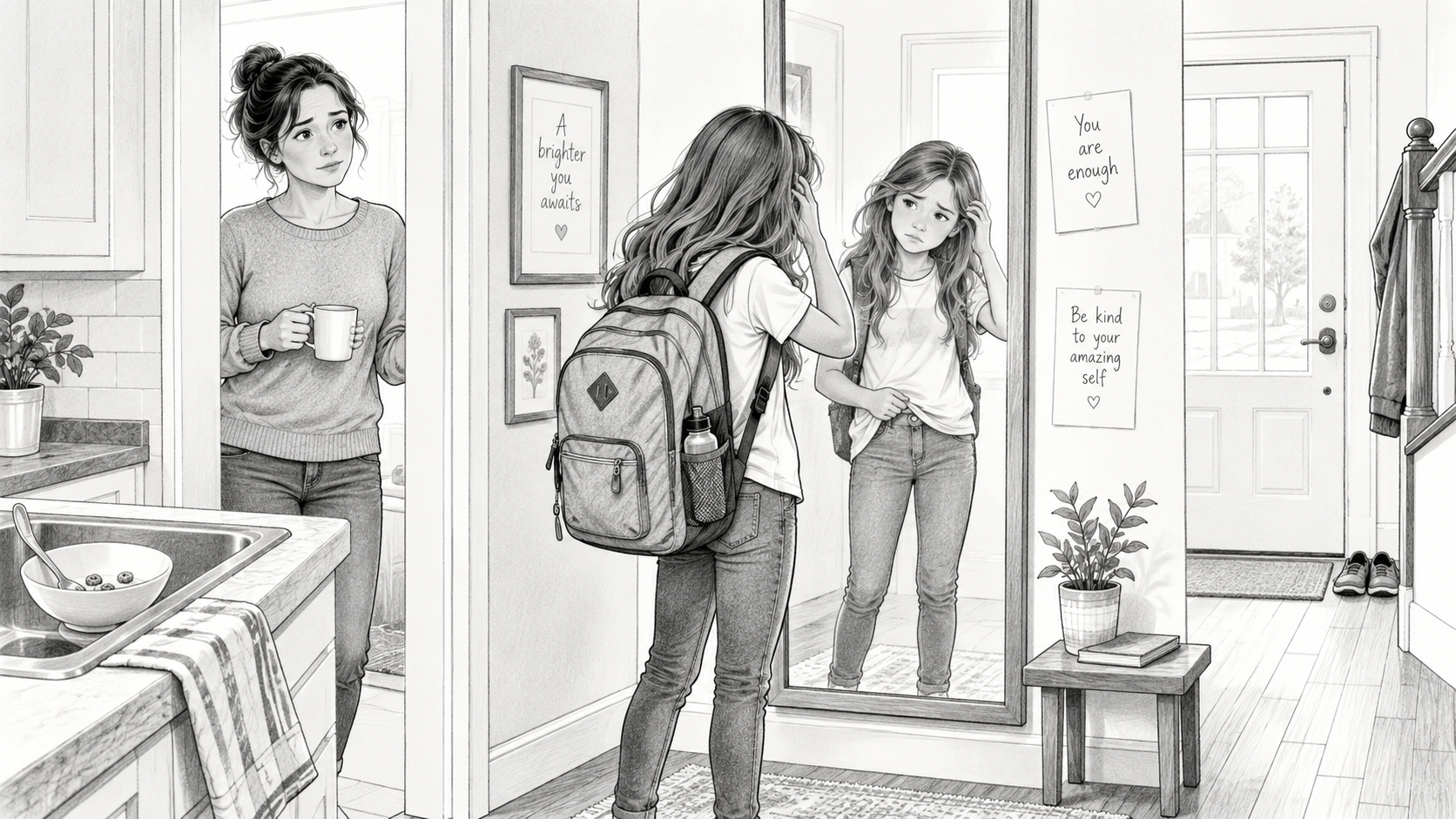
Your daughter may walk past the hallway mirror, stop, back up, adjust her shirt, fix one piece of hair, tilt her face, frown, and then announce she is not going to school.
Nothing happened, technically.
Her backpack is packed. Her shoes are on. The cereal bowl is still sitting in the sink with three soggy pieces left in it. The bus is six minutes away. But now the entire morning has shifted because one mirror moment changed how she feels in her body.
A parent can look at that scene and think, “Why does this matter so much?”
That question is understandable. It is also incomplete.
Because for a tween girl, appearance is often not only about appearance. It can become the place where insecurity gathers when she does not know where else to put it. A shirt is not only a shirt. A photo is not only a photo. A pimple is not only a pimple. They become evidence. They become proof. They become the thing she uses to decide whether she can walk into the room without feeling exposed.
That does not mean every concern should be treated like a crisis. It means parents need to understand what they are looking at before they respond.
It May Look Like Vanity, But It Often Feels Like Exposure
When a girl starts caring more about how she looks, adults can get nervous. They may worry she is becoming shallow. They may worry social media is getting to her. They may worry she is losing the easy confidence she had when she was younger, when she wore mismatched socks and a shirt with pancake batter on it without giving anyone’s opinion a second thought.
Sometimes parents respond by minimizing the concern.
“You look fine.”
“Nobody is looking at you.”
“That pimple is tiny.”
“Your outfit is not a big deal.”
Those sentences are usually meant to calm her down. But they can accidentally make her feel more alone with the feeling. She is not only asking whether the pimple is visible. She is asking whether everyone else can see the part of her that suddenly feels wrong to her.
That is a different question.
Puberty changes the body, but it also changes the experience of being looked at. A girl may become aware of her chest, her skin, her hair, her smell, her legs, her stomach, or the way clothes sit on her body. She may start noticing who gets complimented, who gets teased, who gets attention, and who seems to disappear. She may not explain any of this directly. She may only say, “I hate this shirt.”
The shirt is easier to name than the fear underneath it.
The Mirror Becomes Louder During Puberty
A mirror does not actually say anything, but during puberty it can start feeling like it has opinions.
A girl may check her reflection before school and then check it again in the microwave door, the car window, the phone screen, and the dark part of the television when it is turned off. She may pretend she is not looking. She is looking.
This is not always because she loves herself too much or cares only about looks. Often, it is because her body feels unfamiliar. Things are changing without asking her first. Clothes that used to feel easy now pull, cling, gap, ride up, or make her aware of a body part she did not think about last year.
That awareness can make her irritable.
A parent sees a child changing outfits for the fourth time and thinks about time. A daughter feels the fourth outfit fail and thinks about being seen all day in a body that already feels too noticeable.
Both experiences are real. Only one of them is visible.
This is why the response matters. If the parent only says, “We are going to be late,” the practical problem gets named, but the emotional problem does not. If the parent only reassures, “You look beautiful,” the emotional problem may still not be named, because beauty is not always what she is asking about.
A steadier response might sound like this: “That shirt feels uncomfortable on you today. We still have to leave in five minutes, but I can see something about it is making you feel too noticed.”
That sentence does not solve everything. It does something more useful first. It shows her that you understand the difference between being difficult and feeling exposed.

Photos Can Become Complicated Fast
A daughter who used to make wild faces in every photo may suddenly inspect each picture like she is reviewing evidence in court.
She may zoom in on her face. Delete the picture. Ask to take it again. Hate the angle. Hate her smile. Hate her hair. Hate the way her arm looks pressed against her side. She may say, “Do not post that,” with a sharpness that feels out of proportion to the moment.
It is not out of proportion to her.
Photos freeze the thing she is already trying to understand. They give her a version of herself to evaluate. And if she is entering the age where comparison is becoming louder, the photo can become less about memory and more about measurement.
Parents can accidentally make this harder by arguing with her.
“You look great.”
“That is a good picture.”
“You are being too picky.”
“I wish you could see what I see.”
That last sentence may be loving, but it can still miss the point. She may not be ready to borrow your eyes. She is trying to survive her own.
A better first move is consent. Ask before posting. Ask before sending photos to relatives. Ask before making her body or face part of a public family story. When she says no, do not make it a character lesson about confidence. Respecting the no teaches her that her image belongs to her.
Then, when the moment is calmer, you can talk about the pattern.
“I notice photos feel harder for you lately. I am not going to force you to like every picture. I do want you to know that one awkward angle is not the whole truth about your face.”
That kind of sentence does not demand confidence. It separates a bad photo moment from her entire sense of self.
Compliments Can Backfire When They Become the Whole Language
It is natural to compliment a daughter. Parents see beauty, sweetness, personality, humor, strength, creativity, awkward brilliance, and the weird little way she eats crackers while reading. They want her to know what they see.
But during puberty, appearance-based compliments can start landing differently, especially if they become the main way she hears approval.
“You look so pretty.”
“That outfit is so flattering.”
“You look grown up.”
“You are getting such a nice figure.”
Some of those comments may feel harmless to the adult. To a tween girl, they can add pressure. They can teach her that her changing body is being tracked and assessed, even kindly. They can make her wonder what people noticed before they said something.
This does not mean parents can never say she looks nice. It means the home should not make appearance the loudest category of praise.
Notice more than the body.
“You kept going even after that homework problem frustrated you.”
“You were kind to your friend when she looked left out.”
“You asked a good question.”
“You looked comfortable being yourself today.”
“You handled that awkward moment without turning mean.”
Those comments give her more places to find herself. They remind her that she is not only something to be looked at, approved of, compared, or corrected.
A girl who hears only appearance praise may start performing for approval. A girl who hears her effort, humor, judgment, patience, courage, and honesty noticed has more to stand on when appearance starts feeling unstable.
Do Not Make Her Body the Family Topic
Some families talk about bodies constantly without realizing it.
Who gained weight. Who lost weight. Who looks tired. Who looks good “for their age.” Who should not wear that. Who is eating too much. Who is being “good” with food. Who needs to get in shape. Who has a stomach now. Who looks better in the old photo.
A tween girl does not need every comment to be directed at her for the lesson to land.
She listens to how bodies are discussed in the room. She learns what gets praised, what gets mocked, what gets whispered, and what gets treated like failure.
This is where parents often underestimate the background noise.
A mother criticizing herself in the mirror may think she is only talking about her own body. A daughter may hear a rule being formed. A relative commenting on someone’s weight may think it is casual. A girl may file it away as evidence that bodies are always up for review.
The shift does not have to be dramatic. Start by making fewer body comments out loud. Do not narrate your diet. Do not talk about earning food. Do not make weight the opening comment when you see someone. Do not let relatives casually evaluate your daughter’s body as if kindness makes it acceptable.
If someone says, “She is filling out,” you can answer calmly: “We are not commenting on her body.”
That sentence may feel uncomfortable the first time. It is still clear.
Your daughter may act like she did not hear it.
She probably did.
Her Clothing Choices May Be About Control
A tween girl’s clothing choices can become confusing because they may change quickly.
She may want oversized clothes one week and fitted clothes the next. She may reject a shirt because the sleeves feel wrong. She may wear the same sweatshirt repeatedly until it becomes less of a sweatshirt and more of a portable hiding place. She may suddenly care about brands, colors, waistbands, bra lines, or whether a shirt shows anything when she raises her arms.
Clothing sits directly between the body and the world. So when the body feels unfamiliar, clothing becomes a way to manage exposure.
This is why power struggles over clothes can escalate fast. The parent may be thinking about weather, dress codes, cost, or laundry. The daughter may be thinking, “This makes my body feel noticeable in a way I cannot handle today.”
Both matter.
You can hold practical limits without mocking the intensity.
“That shirt does not work for school because it breaks the dress code. I can tell you like how it feels on you, so we can find another option that gives you that same feeling without causing a problem.”
Or:
“I know you want the sweatshirt. It is 91 degrees, so you cannot wear it outside all day. You can bring it in your backpack.”
The goal is not to let clothing run the house. The goal is to understand that clothing may be carrying more emotional weight than it appears to carry.

Comparison Often Starts Before She Can Explain It
A tween girl may not say, “I am comparing my body to the girls in my class, and now I feel behind.”
She may say, “Everyone has better hair than me.”
She may say, “My legs look weird.”
She may say, “I hate my skin.”
She may ask if she needs a bra, then get furious when you answer. She may ask if she smells weird after gym and then reject every practical suggestion. She may study another girl’s outfit, laugh too loudly, then become quiet on the car ride home.
Comparison often enters before a girl knows how to name it. It can attach itself to body hair, acne, height, chest development, weight, clothing, athletic ability, popularity, and photos. It does not always look like sadness. Sometimes it looks like irritability, criticism, withdrawal, perfectionism, or sudden contempt for things she used to like.
Parents cannot remove every comparison trigger. They can help their daughter interpret what comparison does.
“You are noticing a lot about other girls right now. That can happen during puberty. But noticing differences is not the same as proving something is wrong with you.”
That sentence matters because comparison often pretends to be information. It tells a girl, “Look, she has that and you do not.” Or, “Look, you have that and she does not.” Then it tries to turn the difference into a ranking.
Girls need help separating observation from judgment.
Different does not mean better. Earlier does not mean better. Later does not mean worse. More attention does not mean more value.
Those are not slogans. They are corrections to the math comparison tries to teach.
When to Step In More Directly
Most appearance concerns during puberty need calm attention, not panic. But parents should pay closer attention when appearance worries start limiting daily life.
Notice if your daughter regularly refuses school because of how she looks, stops participating in activities she used to enjoy, avoids eating around others, makes repeated harsh comments about her body, seems distressed by normal body changes, or spends so much time checking, hiding, or changing that ordinary routines become difficult.
This is educational information, not a diagnosis. If you are concerned about your daughter’s eating, body image, mood, anxiety, self-harm, or ability to function, talk with her pediatrician or a qualified mental health professional. It is better to ask early than to wait until the pattern becomes harder to interrupt.
Stepping in does not have to sound dramatic.
“I have noticed getting dressed has become painful most mornings. I am not mad at you. I do think we need more support with this because it is starting to take over your day.”
That sentence names the behavior, removes blame, and treats the concern seriously without making the child feel like the problem.

Give Her More Than Appearance to Come Back To
A tween girl who suddenly cares how she looks is not shallow. She is living through a stage where her body, her social world, and her self-awareness are all changing at once. Some days she may handle that with confidence. Some days she may handle it by changing shirts six times and accusing the mirror of ruining her life.
Parents do not have to respond perfectly. They do have to notice what the behavior may mean.
The mirror may be about exposure. The outfit may be about control. The photo may be about comparison. The irritation may be about embarrassment. The silence may be about needing privacy without knowing how to ask for it.
When you understand the pattern, you can respond with more steadiness.
You can stop arguing with every insecurity as if logic alone will fix it. You can stop making beauty the only reassurance. You can stop treating every appearance concern as vanity. You can hold boundaries while still seeing the fear underneath.
Your daughter needs practical language for her changing body. She also needs a home where her body is not constantly discussed, judged, corrected, joked about, or turned into evidence of who she is becoming.
She is more than the mirror moment.
She may not know that yet.
So you keep giving her more places to find herself.